Radwag Balances and Scales - Advanced Weighing Technologies
2023-08-04

Balances and Scales Legalization – What Does It Consist of and to Whom Does It Apply?

Balances and Scales Legalization – What Does It Consist of and to Whom Does It Apply?

Balances and Scales Legalization – What Does It Consist of and to Whom Does It Apply?

Electronic balances and scales are an essential piece of equipment for laboratories, pharmacies, grocery stores and many other service and retail outlets. Balances and scales used in these places must, according to the letter of the law, be legalized, and using the correct terminology, have a conformity assessment performed. What and who is affected by the legalization (conformity assessment) of balances or scales and when should their re-legalization be carried out?

Note: in this article, the colloquially used term “legalization” means ‘conformity assessment’. The term “legalization” is more understandable and more commonly used by users of balances and scales.

Who Is Affected by Balances and Scales Legalization (Conformity Assessment)?

All non-automatic balances and scales, which, according to § 3 of the Regulation of the Minister of Development of June 2, 2016 on requirements for non-automatic balances and scales (Journal of Laws, item 802), must meet the requirements specified in EU legislation, if their purpose is:

  • determining the mass in trade
  • determining mass for the calculation of a fee, duty, tax, premium, discount, penalty, remuneration, compensation or similar payments
  • determining mass in the application of laws and in the rendering of opinions in legal proceedings by experts and experts
  • determining the weight of a patient in medical practice for monitoring, diagnosis and treatment
  • determining mass in the preparation of prescription drugs in pharmacies and in analyses performed by medical and pharmaceutical laboratories
  • determining the price on the basis of weight in consumer sales and in the packaging of goods,

are subject to legalization (conformity assessment) before being placed on the market.

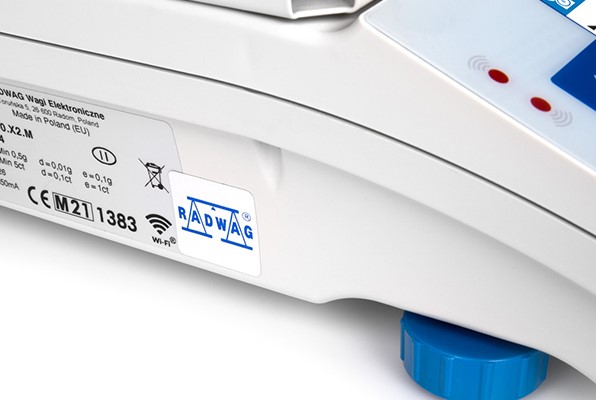
Balances and Scales Legalization (Conformity Assessment) – What Does It Consist in? Markings
Balances and Scales Legalization – What Does It Consist of and to Whom Does It Apply?

Before legalized balances or scales are placed on the market or put into service, they must receive a “CE” marking and an additional metrological marking (the capital letter M, the last two digits of the year in which this was placed on the balance or scale, surrounded by a rectangle whose height is the same as the height of the CE marking, and the number of the notified body). If such marking is on the balance or scale, it means that:

  • the balance or the scale is subject to mandatory reverification,
  • legalization (conformity assessment) was carried out before the instrument was placed on the market or put into service,
  • legalization (conformity assessment) certifies the conformity of the balance or the scale with the requirements.

Balances and Scales Legalization (Conformity Assessment) – What Documents?

RADWAG has the right to independently perform legalization (conformity assessment) of its products. In this area it is supervised by a notified body through annual audits.

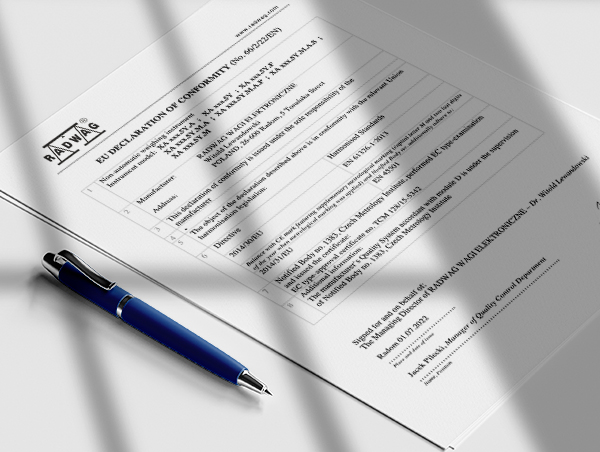
In addition to the CE mark and additional metrological marking applied to the balance or the scale mentioned above, a document in the form of a Declaration of Conformity is also attached.

The Declaration of Conformity is a statement by the manufacturer, installer, their authorized representative or private importer that the balance or the scale complies with the requirements.
Balances and Scales Legalization – What Does It Consist of and to Whom Does It Apply?

After legalization (conformity assessment), security features are applied to specific locations on the balance or scale to protect against unauthorized modification of readjustment or replacement of components by unauthorized persons. The user can ask his supplier about such locations and the applied features when taking delivery of the balance or scale after legalization (conformity assessment).

In addition to the balance or scale, the customer should receive a user’s manual with clearly formulated instructions on the principles of its operation.

Balances and Scales Re-Legalization – When?

According to Article 8k paragraph 2 item 2 of the Act of May 11, 2001. Law on Measures (Journal of Laws of 2022, item 2063), balances and scales should be submitted for re-legalization before the deadline specified in Table No. 2 of Appendix No. 5 to the Regulation of the Minister of Entrepreneurship and Technology of March 22, 2019 on legal metrological control of measuring instruments (Journal of Laws, item 759 and of 2022, item 1179). The deadline is counted from the first day of December of the year, the marking of which was applied to the balance or scale during legalization (conformity assessment).

In addition, the balance or the scale should be submitted for reverification, among other things, in the event that the markings or security features applied during legalization are damaged or destroyed and repaired. This is stipulated in Article 8k paragraph 2 of the Weights and Measures Law.

The user of the balance or the scale during its use is obliged to have a valid certificate of reverification in the form of only a verification mark, a certificate of verification, or a verification mark or a certificate of verification. They prove legal metrological control and confirm that the checked balance or scale meets technical and metrological requirements.

Where Can I Find Information about the Fact that a Particular RADWAG Balance Is Legalized?

You will find information about the legalization (conformity assessment) of a particular balance or scale on the corresponding subpage (in the case of the ultra-microbalance UYA 2.5Y, it will be the subpage). This is the last information in the “Datasheet” marked as a capital letter M.


Do you have any questions? Something you don’t know? Our specialist will be happy to clear your doubts.

Balances and Scales Legalization – What Does It Consist of and to Whom Does It Apply?

Newsletter

Subscribe to the newsletter if you would like to receive RADWAG news.

View more
Polish Quality on a Global Scale. Discover RADWAG
2026-09-09
2 min read

Polish Quality on a Global Scale. Discover RADWAG

Hundreds of carefully considered decisions, in-house production and attention to detail – discover what lies behind the quality of our products.
More  ➜
Is It Possible to Weigh Something You Cannot Touch? On the Unusual Uses of Laboratory Balances
2026-08-25
5 min read

Is It Possible to Weigh Something You Cannot Touch? On the Unusual Uses of Laboratory Balances

When we think of weighing, we usually picture a simple process: we place an object on a weighing pan and read its mass. In reality, modern metrology goes far beyond this scenario.
More  ➜
The Use of Analytical Balances. Why Is Measurement Accuracy so Important?
2026-08-11
4 min read

The Use of Analytical Balances. Why Is Measurement Accuracy so Important?

In laboratories, every fraction of a gram can affect the final test result. That is why analytical balances are among the most important measuring instruments used in research, industrial, pharmaceutical and university laboratories.
More  ➜
Is Mass a Constant? Factors Affecting the Measurement Result
2026-07-28
4 min read

Is Mass a Constant? Factors Affecting the Measurement Result

At first glance, the answer seems obvious. If an object has a mass of 100 grams, it should always weigh 100 grams. However, in metrological practice, the situation is much more complex.
More  ➜
Electrostatics – the Silent Precision Killer
2026-07-14
4 min read

Electrostatics – the Silent Precision Killer

On the one hand, accurate balance, controlled conditions and an experienced operator; on the other, inconsistent results. One of the most commonly overlooked culprits is electrostatic charge – a phenomenon which is exceptionally effective at interfering with mass measurements.
More  ➜
Analytical vs. Precision Balances – When Are You Paying too Much, and When Are You Taking a Risk?
2026-06-30
5 min read

Analytical vs. Precision Balances – When Are You Paying too Much, and When Are You Taking a Risk?

Choosing the right laboratory balance often seems straightforward – until the moment you have to make a purchase decision.
More  ➜
How Often Should a Balance Be Calibrated in a Lab Environment?
2026-06-17
1 min read

How Often Should a Balance Be Calibrated in a Lab Environment?

Calibrating a laboratory balance is essential for obtaining reliable measurement results. Find out how often it should be done and in which situations it is absolutely essential.
More  ➜
What Is ‘Calibration’ and How Does It Differ From Adjustment?
2026-05-26
3 min read

What Is ‘Calibration’ and How Does It Differ From Adjustment?

‘Calibration’ is a term historically associated with the balance adjustment process. Adjustment, on the other hand, is a set of activities through which a measuring instrument is made to operate in accordance with its intended use.
More  ➜
Effective Laboratory Management. How Does Process Automation Improve Efficiency?
2026-05-12
5 min read

Effective Laboratory Management. How Does Process Automation Improve Efficiency?

The growing number of tests, the need to maintain the highest quality of results, and the limited availability of qualified staff mean that laboratory management today requires not only organisational skills but also the informed use of modern technologies.
More  ➜
Moisture Analyzer as a Quality Control Tool in Plastics Production – Accuracy and Effectiveness of RADWAG Technology
2026-04-28
3 min read

Moisture Analyzer as a Quality Control Tool in Plastics Production – Accuracy and Effectiveness of RADWAG Technology

In modern plastics production, precise control of granule moisture content determines the stability of the technological process, the strength of parts and the minimisation of material losses. Read how RADWAG’s technological solutions allow your company to achieve full repeatability and process safety.
More  ➜
How Much Does a Lab Technician’s Time Cost You? The Hidden Costs of Manual Calibration
2026-04-14
4 min read

How Much Does a Lab Technician’s Time Cost You? The Hidden Costs of Manual Calibration

Although manual pipette calibration is still widely used, it significantly increases working time and generates hidden costs which often go unnoticed in day-to-day laboratory operations. Fortunately, there are modern solutions available which can boost laboratory productivity.
More  ➜
Pallet Scale vs. Beam Scale – a Complete Guide to Industrial Scales
2026-03-31
5 min read

Pallet Scale vs. Beam Scale – a Complete Guide to Industrial Scales

How does a U-type pallet scale differ from a beam scale? Are beam scales suitable for weighing machines and tanks? Why is it worth buying a pallet scale directly from the manufacturer? You will find answers to these and other questions in this article.
More  ➜
What Does ‘Precision Balances’ Mean?
2026-03-17
2 min read

What Does ‘Precision Balances’ Mean?

Are precision balances inherently more precise than other balances? After all, the range of electronic balances includes laboratory balances, which are even more accurate, so where does this name come from?
More  ➜
« Back

© 2026 RADWAG Balances and Scales.

All rights reserved.