Is It Possible to Weigh Something You Cannot Touch? On the Unusual Uses of Laboratory Balances

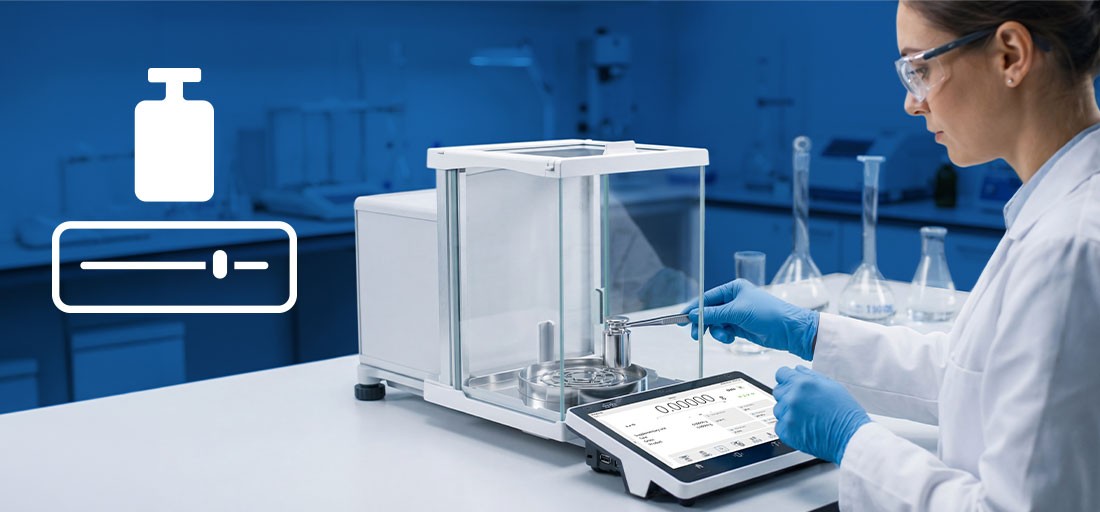
When we think of weighing, we usually picture a simple process: we place an object on a weighing pan and read its mass. In reality, modern metrology goes far beyond this scenario. Laboratory balances can provide information about the properties of materials, measure physical phenomena, and even indirectly determine the parameters of substances which… cannot simply be placed on the weighing pan.
Does that sound paradoxical? That is precisely why weighing is one of the most versatile measurement methods used in modern science and industry.
When Mass Is Just the Beginning
A modern balance does not measure what lies on the weighing pan – it measures the force acting on the measuring system. Using appropriate research methods, this information can be used to determine many other parameters. This is precisely why a single balance can be used not only to determine mass, but also to calculate density, monitor sorption processes, analyse material changes or conduct research into the interaction of liquids and gases.
How Do You Weigh Something You Cannot Touch?
A good example is the measurement of buoyant force. If a sample is immersed in a liquid, its apparent mass will decrease by a value corresponding to the buoyant force described by Archimedes’ principle. For the balance, this means a change in load which can be measured with very high accuracy. On this basis, it is possible, amongst other things, to:
- Determine the density of solid materials
- Examine the porosity of samples
- Quality control of components made from metals, ceramics or plastics
- Identification of materials with very similar masses.
The balance does not measure density directly – it records a slight change in the force acting on the measuring system, and appropriate calculations allow the desired parameter to be determined.
Air Also Matters
Although we don’t usually notice it, air also exerts a buoyant force. This is of little significance for everyday measurements, but when weighing to the nearest microgram, the effect of air can be comparable to the value of the measured signal.
For this reason, laboratories carrying out high-precision measurements take into account, amongst other things:
- Temperature
- Atmospheric pressure
- Air humidity
- Air density.
Based on this data, appropriate corrections can be made so that the result better reflects the actual mass of the object being tested.
Can Gas Be Weighed?
Gases are not weighed in the same way as solids, but their mass can be determined using gravimetric methods. The simplest example is weighing a sealed container – first when empty, and then after it has been filled. The difference in the readings corresponds to the mass of the gas inside. A similar principle is used in:
- Testing of gas-absorbing materials
- Emissions analysis
- Leak tests
- Monitoring of technological processes.
In such applications, the balance does not measure the gas directly. It records the change in mass of the entire system, from which the quantity of the accumulated substance can be determined.
When a Sample Changes in Mass of Its Own Accord
Some materials constantly exchange moisture or other substances with their surroundings. Paper, wood, building materials, pharmaceuticals and food can absorb or release water. The changes may be slight, but modern laboratory balances allow them to be monitored almost in real time. This makes it possible to investigate:
- The rate at which materials lose moisture
- Ageing processes
- Product stability
- Sorption and desorption kinetics
- The durability of packaging.
In many laboratories, it is precisely this change in mass that serves as the most sensitive indicator of the physical and chemical processes taking place.
Weighing as a Research Tool
Increasingly, a balance is becoming part of a larger measurement system. It works in conjunction with climatic chambers, laboratory furnaces, dispensers and automation systems. This allows one to observe how the mass of a sample changes under the influence of temperature, humidity, time or the action of specific substances. Such measurements are used, amongst other things, in:
- Materials laboratories
- The pharmaceutical industry
- Food testing
- Analytical chemistry
- Materials engineering
- Environmental protection.
The Greater the Accuracy, the More Physics
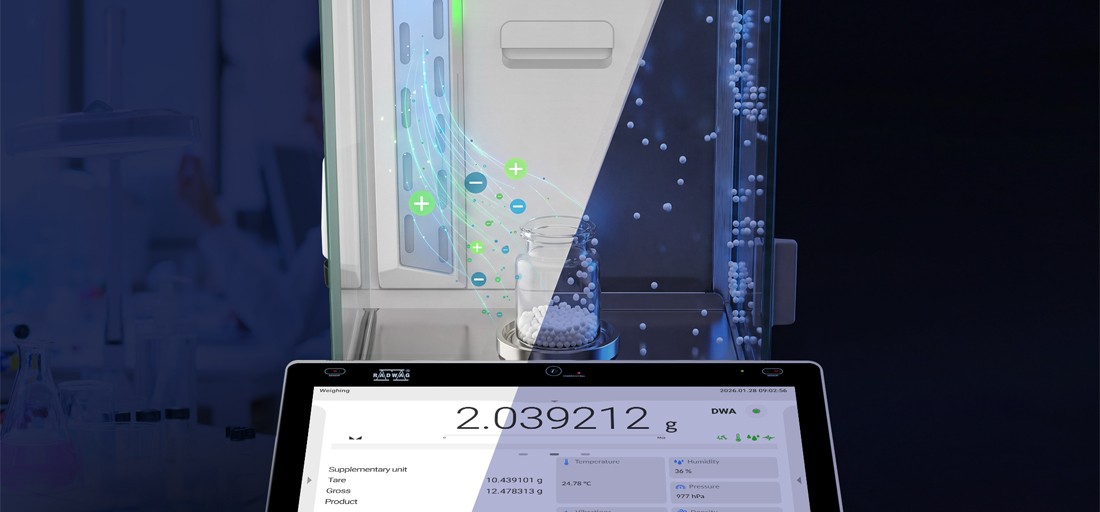
When taking measurements at the microgram or nanogram level, phenomena that we do not normally notice in everyday life become significant. The result may be affected by, amongst other things:
- Vibrations of the base
- Air movement caused by opening a door
- Electrostatic charges
- Temperature differences between the sample and its surroundings
- Magnetic fields
- Heat transferred via the operator’s hand.
Therefore, the design of modern laboratory balances requires not only advanced electronics, but also a very good understanding of mechanics, physics and metrology.
The Balance as a Precise Detector of Changes
Although at first glance a balance appears to be a simple device, in reality it is an extremely sensitive force detector. It is precisely this sensitivity which enables the balance to be used in research that goes far beyond the conventional weighing of objects. Measuring density, analysing gas absorption, studying changes in moisture content or observing processes occurring within materials – all these activities share a common denominator. The starting point is the precise measurement of minute changes in the force acting on the measuring system.
Therefore, the answer to the question posed in the title is: yes – it is possible to weigh much more than just the objects placed on the weighing pan. In modern metrology, mass often becomes a tool for understanding phenomena that cannot be seen with the naked eye, and sometimes cannot even be touched directly.