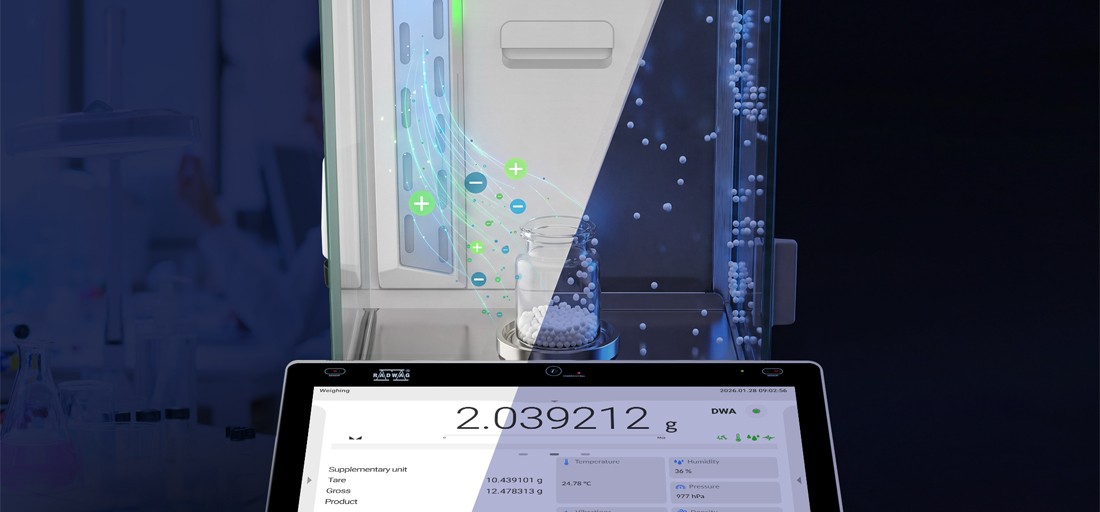
Analytical vs. Precision Balances – When Are You Paying too Much, and When Are You Taking a Risk?


Choosing the right laboratory balance often seems straightforward – until the moment you have to make a purchase decision. In practice, many laboratories, quality control departments and manufacturing companies face the same question: do they need an analytical balance, or is a precision balance sufficient? The problem is that a device which is too advanced entails unnecessary costs, whilst a balance which is too ‘simple’ can lead to errors, claims or even issues with process compliance. So where does the line lie between a sensible investment and an unnecessary risk?
What is the Difference Between an Analytical Balance and a Precision Balance?
The main difference concerns the readability and the operating conditions.
1. Analytical balance
Analytical balances offer very high measurement accuracy – typically:
- mg (0.0001 g)
- 0.01 mg in more advanced models.
They are equipped with a draft shield and designed for use in controlled laboratory conditions. Even slight air movement, table vibrations or temperature changes can affect the weighing result. These devices are used, amongst other things, in:
- Chemical laboratories
- Pharmacy
- Scientific research
- R&D laboratories
- Micro-sample analysis.
2. Precision balance
Precision balances offer lower readability but greater versatility and ease of use. Typical readout resolutions are:
- 1 mg
- 0.01 g
- 0.1 g.
These balances are well suited to applications where fast and stable measurement matter, but the analysis of trace quantities of substances is not required. Most common applications:
- Quality control,
- Manufacturing
- Warehouses
- Jewellery
- Formula preparation
- Weighing of components.
When Are You Overpaying for an Analytical Balance?
In practice, companies very often buy an analytical balance ‘just in case’. The problem is that greater readability does not always translate into real value for the process.
Example 1: weighing production components
If an operator measures ingredients with a tolerance of ±0.1 g, purchasing a balance with a readability of 0.0001 g will not improve the quality of the process. What is more, it will:
- Prolong the measurement stabilisation time
- Increase environmental requirements
- Raise the cost of purchase and maintenance.
In such a case, a robust precision balance is a better solution.
Example 2: checking the weight of the finished product
When checking packaging, parts or mechanical components, analytical accuracy is usually of no practical significance. What matters is:
- Speed
- Durability
- Repeatability
- Ease of use.
Purchasing an analytical balance for such applications simply means overpaying for features which will not be used.
When Does Cost-Saving Become a Risk?
However, there are situations in which choosing a too ‘simple’ balance can have serious consequences.
1. Pharmaceuticals and chemical laboratories
When weighing active substances, even the slightest deviation can affect:
- The composition of the preparation
- Test results
- Product safety
- Compliance with standards.
In such cases, a precision balance may prove insufficient.
2. Analysis of small samples
If a sample weighs a few milligrams, a balance with a 1 mg resolution can generate a very large relative error. For example:
- Sample: 5 mg
- Reading error: ±1 mg.
This represents up to 20% measurement uncertainty. In such applications, an analytical balance is essential.
Audits and Regulatory Requirements
In many industries, the following are of key importance:
- GMP procedures
- GLP
- ISO
- Validation documentation.
If a process requires a specific level of measurement accuracy, using the wrong balance may result in problems during an audit.
How Do You Choose a Balance Which Suits Your Actual Needs?
The best approach is to analyse the weighing process, rather than simply choosing the ‘most accurate’ instrument. It is worth asking yourself a few questions:
1. What mass do you weigh most often?
A different balance will be suitable for samples weighing 2 mg, and another for components with a mass of 2 kg.
2. What is the acceptable tolerance?
This is a key parameter. The balance’s readability should be significantly better than the required process tolerance.
3. In what environment will the device operate?
An analytical balance requires:
- A stable work surface
- Minimal vibration
- Controlled temperature
- Protection from draughts.
If the device is to be used on the production floor, a precision balance may be more practical.
4. Is the weighing subject to standards or audits?
If so, it is worth considering:
- Verification
- Qualification
- Validation
- Compliance with quality procedures.
The most common misconception: ‘the more accurate, the better’
This is one of the biggest myths in the field of laboratory weighing. Greater accuracy:
- Does not always improve process quality
- Often increases costs
- Can hinder day-to-day work
- Requires more stringent environmental conditions.
A well-chosen balance is not the ‘best on the market’, but the one that meets the actual requirements of the application.
Summary
Analytical and precision balances are devices for different applications – and it is the right choice which determines work efficiency and process safety.
- If you need ultra-precise measurements of small samples, an analytical balance is a must.
- If fast, stable and convenient weighing in day-to-day work is what matters, a precision balance is often the better choice.
The greatest costs arise when the instrument is poorly chosen:
- One that is too advanced generates unnecessary expenditure
- One that is too simple increases the risk of errors and quality issues.
Therefore, before purchasing, it is worth analysing not only the technical specifications, but also – and above all – the actual needs of the process.