Pallet Scale vs. Beam Scale – a Complete Guide to Industrial Scales
Pallet scales and beam scales are indispensable in warehouses, production halls and logistics centres where fast and accurate weighing of heavy loads is essential. Their design allows pallets, barrels and other non-standard goods to be weighed without the need for additional lifting equipment or complex machinery. Choosing the right type of scale – pallet or beam – allows you to optimise warehouse processes, increase work efficiency and reduce the risk of errors in the transport and storage of goods. How does a U-type pallet scale differ from a beam scale? Are beam scales suitable for weighing machines and tanks? Why is it worth buying a pallet scale directly from the manufacturer? You will find answers to these and other questions in this article.
What is the Difference Between a U-Type Pallet Scale and a Beam Scale?
Both are used to weigh pallets, but they work slightly differently. The difference mainly concerns their design, the way the pallet is positioned and their application.
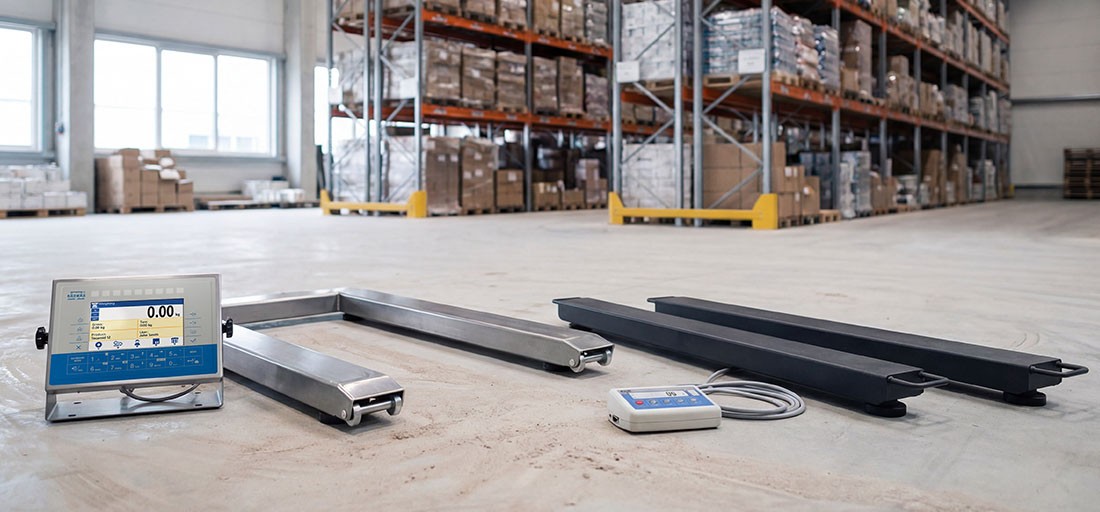
A U-type pallet scale has a U-shaped design which forms a frame open on one side. The user places the pallet in the space between the arms of the scale and usually drives the pallet truck directly onto its surface. Strain gauge sensors located in the structure measure the pressure exerted by the load and then convert it into a weight result displayed on the terminal. This solution makes weighing standard pallets, especially Euro pallets, quick and convenient, as it does not require precise positioning of separate elements.
The beam scale consists of two separate weighing beams which are placed parallel under the pallet or load. The distance between the beams can be adjusted to the width of the object being weighed, allowing for greater flexibility of use. During weighing, the weight is distributed over both skids, and built-in strain gauge sensors record the pressure and transmit the signal to the weighing terminal, which calculates and displays the weight. This solution is particularly suitable for non-standard pallets or loads of different sizes, where it is necessary to be able to adjust the spacing of the weighing elements.
Why Is Pallet Scale Mobility Crucial in a Warehouse?
Pallet scale mobility is crucial in a warehouse because it allows the device to be quickly moved to the place where goods are currently being received or shipped, which improves work organisation. Transport rollers allow the scale to be easily moved without the need for additional equipment. Ergonomic handles ensure a comfortable and secure grip, enabling the operator to manoeuvre the device efficiently even in confined spaces.
Do I Need a Legalised Pallet Scale to Ship Goods?
Yes. If the scale is used to determine the weight of goods for pricing purposes, legalization (conformity assessment) is required by law.
Scales which are subject to legalization are those used:
- In trade
- When preparing prescription medicines in pharmacies
- In medical facilities
- In analytical and pharmaceutical laboratories
- When issuing opinions in court proceedings by experts and specialists
- During customs inspections
- In calculating market fees, taxes, bonuses, penalties, discounts, compensation, etc.
What IP Rating Is Required for Industrial Scales?
In dry warehouses, IP65 protection is sufficient. In areas with high dust or humidity levels, as well as in the food industry, scales made of stainless steel with IP67 or IP68 protection are recommended. RADWAG stainless steel pallet scales have a terminal with IP 66 / 67 / 69, and RADWAG stainless steel multifunctional beam scales have IP 66 / 68.
What Is the Maximum Capacity of RADWAG Pallet Scales?
U-type pallet scales, including stainless steel pallet scales, have a maximum capacity of 3,000 kg, or 3 tonnes. Beam scales, including stainless steel beam scales, have a maximum capacity [Max] of 6,000 kg, or 6 tonnes.
Can Pallet Scales Be Connected to an ERP or WMS System?
Yes, RADWAG weighing terminals support interfaces such as RS232, USB, Ethernet and Wi-Fi®, which allows for automatic data transfer to SAP or warehouse systems and to the cloud.
What Does Readability (Division) Mean in a 1500 kg Pallet Scale?
Readability, or division, determines the smallest change in weight which the scale will show. In standard pallet scales with a capacity of 1500 kg, it is usually 500 g.
Are Beam Scales Suitable for Weighing Machines and Tanks?
Definitely yes. Thanks to the possibility of freely spacing the skids, Beam Scales can be placed under the support points of heavy structures, machines or large crates that do not fit on a standard platform.
How Often Should a Pallet Scale Be Calibrated?
It is recommended to calibrate the scale periodically (for example, once a year) to confirm its traceability and maintain compliance with ISO quality standards.
Why Is It Worth Buying a Pallet Scale Directly From the Manufacturer?
Purchasing directly from RADWAG guarantees the lowest price without margins and intermediaries, quick access to factory service and the certainty of purchasing original spare parts.
__________
Wi-Fi® is a registered trademark of Wi-Fi Alliance®.