How Often Should a Balance Be Calibrated in a Lab Environment?


As the value of gravitational acceleration varies depending on geographical location, each balance must be adjusted to the location where it will be used to measure mass. Device adjustment is required when it is first installed at its place of use, when its location is changed, and when the ambient temperature changes. To ensure the highest possible weighing accuracy, a correction factor for the balance’s readings relative to a mass standard should be periodically entered into the device’s memory; this is known as balance calibration (adjustment).
Calibration should be carried out:
- Before starting to weigh
- If there are long intervals between successive series of measurements
- When the temperature has changed by more than 3°C.
Types of calibration (adjustment):
- Automatic internal calibration
Triggered by changes in temperature and the passage of time.
- Manual internal calibration
Initiated via the balance’s keypad.
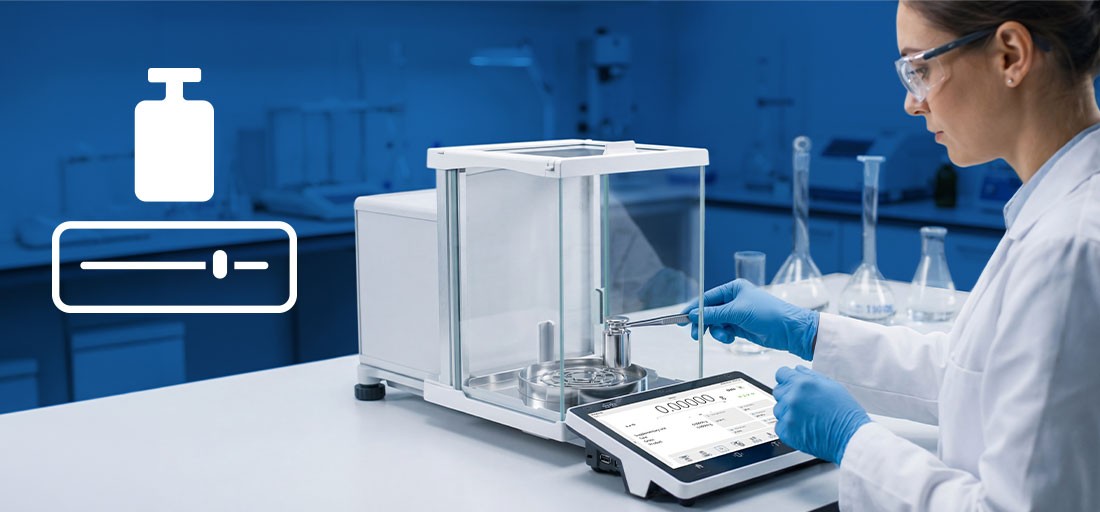
- External calibration
Performed using an external mass standard of a declared mass, which cannot be modified. External adjustment is possible for balances which are not a subject to conformity assessment (verification).