Electrostatics – the Silent Precision Killer
On the one hand, accurate balance, controlled conditions and an experienced operator; on the other, inconsistent results. One of the most commonly overlooked culprits is electrostatic charge – a phenomenon which is exceptionally effective at interfering with mass measurements.
An Invisible Force, a Real Problem
Electrostatic charges build up easily: during friction, when pouring powders, when working with plastics, or even when taking off gloves. In laboratory conditions, this is an everyday occurrence. The problem arises when a charged weighing vessel or sample begins to interact with its surroundings. Instead of resting on the weighing pan, the material may:
· Stick to the walls of the weighing vessel
· Be attracted to or repelled by components of the weighing chamber
· Migrate from the dosing point
· Cause unstable readings.
As a result, the weighing result no longer reflects the actual mass of the sample.
Where Do Errors Come From?
The effect of electrostatic charge is particularly noticeable in the case of:
· Bulk materials and light powders
· Materials with low conductivity
· Plastic weighing vessels and pans
· Very small masses requiring high resolution.
The higher the sensitivity of the balance, the more pronounced the problem becomes – microgram-level disturbances can significantly affect the result.
Solution: Control of Electrostatic Charges
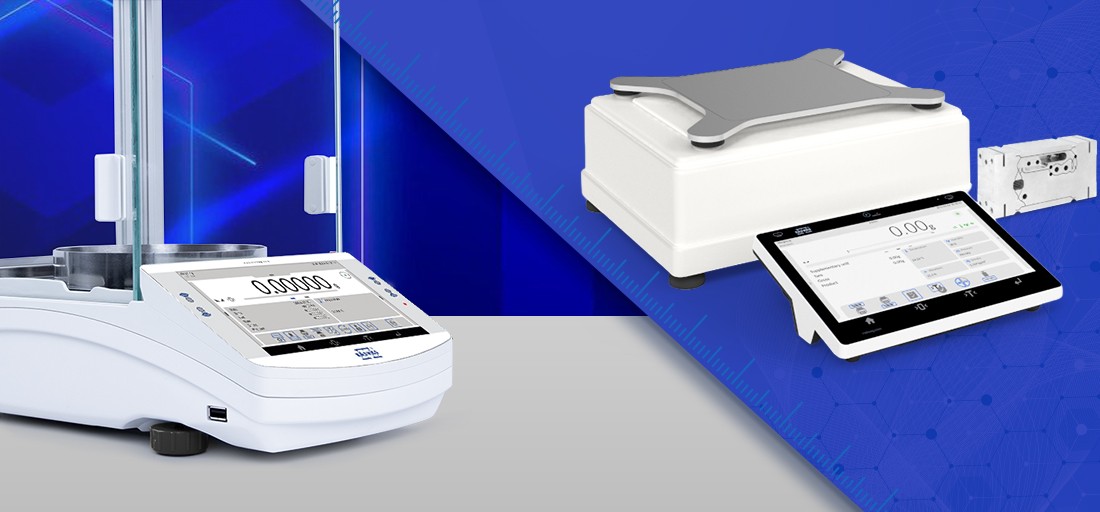
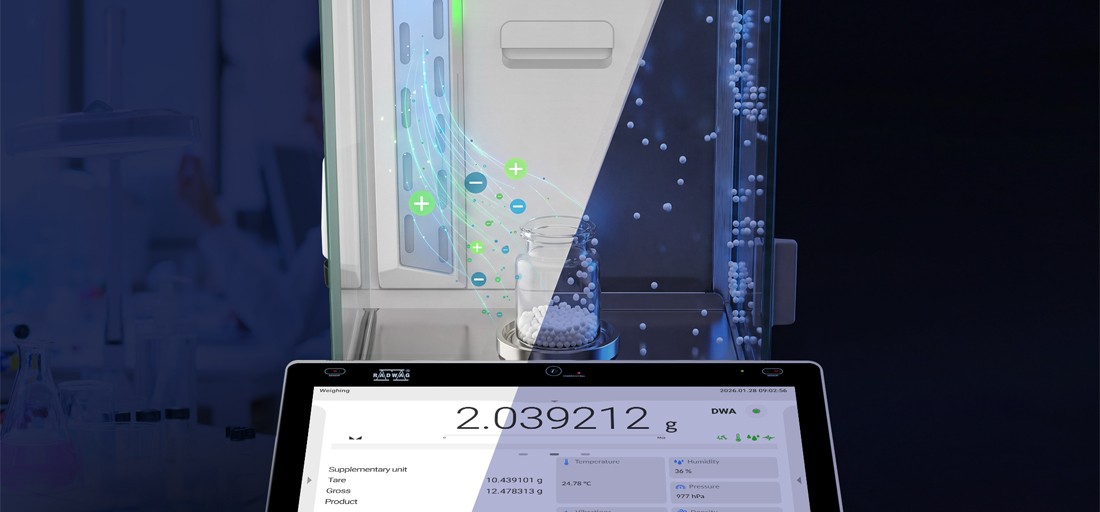
In response to this invisible but significant problem, modern laboratory balances are increasingly equipped with systems to neutralise electrostatic charges. In RADWAG balances, antistatic ionisers play a key role, effectively eliminating accumulated charges in the vicinity of the sample. The XA 5Y.M.A Microbalances and XA 5Y.A Analytical Balances come as standard with an antistatic ioniser built into the weighing chamber. Meanwhile, the 5Y ultra-microbalances, other 5Y microbalances and other 5Y analytical balances, as well as the AS X7 and AS R2 PLUS Analytical Balances, can be fitted with an additional external ioniser, which operates on the same principle as the one built into the balance.
How Does the Ioniser in the Balance Work?
The ioniser generates a stream of positive and negative ions, which neutralise surface electrostatic charges. In practice, this means:
· The elimination of particle attraction and repulsion
· More stable sample behaviour in the weighing chamber
· Faster stable reading
· Improved result repeatability.
Importantly, this process is contactless and does not affect the structure or properties of the sample.
When Does this Make a Difference?
Ionisation is particularly important wherever the highest accuracy is required, namely in:
· Pharmaceutical laboratories
· Quality control
· Chemical analysis
· Materials testing
· Weighing microscopic substances.
In such applications, electrostatic effects are not a minor disturbance – they can determine the reliability of the results.
Accuracy Which Does not Defy the Laws of Physics
Electrostatic charge cannot be eliminated from the laboratory environment, but it can be effectively controlled. That is why, in RADWAG’s modern solutions, ionisers are not merely an add-on – they are an integral part of a system that ensures genuine measurement reliability.