Radwag Balances and Scales - Advanced Weighing Technologies
2026-10-06

Why Do Laboratories Weigh… Air? The Impact of the Environment on Measurement Results

Why Do Laboratories Weigh… Air? The Impact of the Environment on Measurement Results

In a laboratory, the weighing result depends not only on the sample and the balance’s specifications. Environmental conditions also play a role: temperature, pressure, humidity and even CO₂ concentration. When performing very precise measurements, the influence of these factors can no longer be ignored.

Why Does Air Matter?

A sample placed on the weighing pan is surrounded by air, which exerts a buoyant force on it. The magnitude of this force depends, amongst other things, on the density of the air, which varies with temperature, pressure and humidity. Therefore, two measurements of the same sample taken under different conditions may yield slightly different results. The greater the measurement accuracy, the more significant these differences become.

Temperature

Changes in temperature affect both the density of the air and the sample itself, as well as the balance components. A warm or cold sample may also cause convective air movements, which make it difficult to stabilise the reading.

Pressure

Higher pressure means greater air density and, consequently, greater buoyancy. In high-precision measurements, the effect of atmospheric pressure may therefore need to be taken into account.

Humidity and CO₂

Water vapour and carbon dioxide alter the composition and density of the air. In typical measurements, their effect is negligible, but in high-precision metrology, these parameters may also be significant.

How Can Environmental Influences Be Minimised?

A stable temperature, no draughts, proper sample preparation and regular monitoring of environmental conditions are essential for accurate weighing. It is also important to use a suitably selected balance and its functions that support control of the measurement process.

RADWAG Balances – Accuracy Which Takes the Environment Into Account

The smaller the sample mass and the greater the required accuracy, the more important the conditions under which the measurement is performed. That is why RADWAG’s range includes instruments designed for various levels of accuracy – from the 5Y series ultra-microbalances and microbalances, through the 5Y series analytical balances, to the AS X7 analytical balances.

The 5Y series ultra-microbalances and 5Y series microbalances are designed for the most demanding measurements, where even the slightest changes in mass are significant. With such high sensitivity, environmental influences – including air movement, temperature and pressure changes – become particularly significant. The design and features of these balances are intended to facilitate stable, repeatable results even when measurement requirements are exceptionally high.

The 5Y series analytical balances meet the needs of laboratories where high accuracy and thorough control of the weighing process are required. These are solutions for day-to-day research and analytical work, where it is not only the resolution of the balance itself that matters, but also the ability to monitor the conditions under which the measurement is performed.

The AS X7 analytical balances, on the other hand, combine high accuracy, excellent repeatability and design features that minimise the influence of the environment. The series includes models with a readability of 0.01 mg, as well as models with larger weighing ranges. The spacious weighing chamber minimises the impact of air movement on the result, whilst the stable aluminium base ensures the stability of the measuring system.

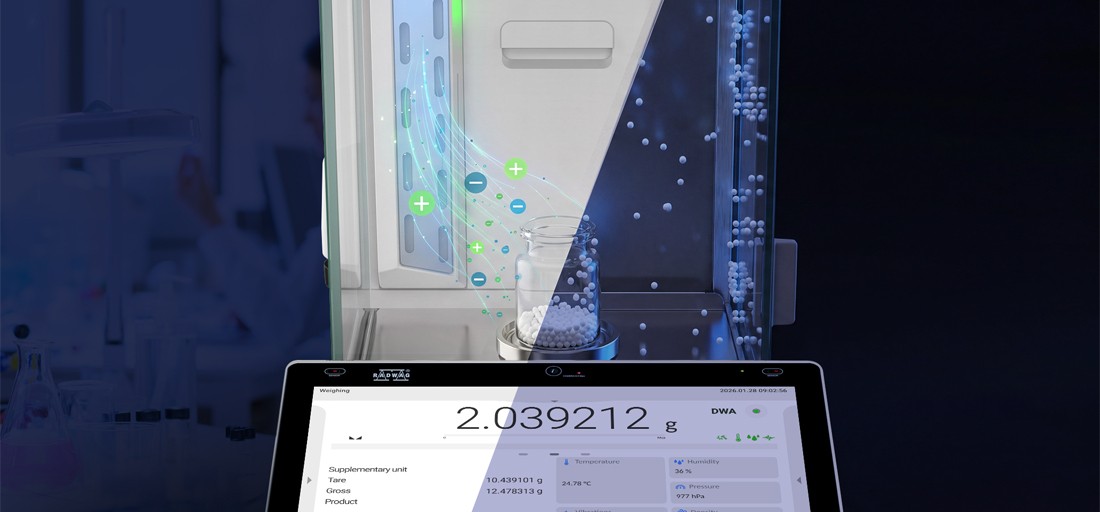
The AS X7 balances can also be integrated with the THBR 2.0 System – Ambient Conditions Monitoring, which allows for the monitoring of environmental parameters relevant to the weighing process. The balance can therefore not only display the result, but also provide information about the conditions under which that result was obtained.

This is particularly important for the most demanding measurements. The greater the accuracy of the balance, the more difficult it is to consider the measurement result in isolation from the environment. Temperature, humidity, pressure and air properties become part of the entire measurement process, and a suitably selected balance helps to control this process.

Newsletter

Subscribe to the newsletter if you would like to receive RADWAG news.

View more
RADWAG Metrology Symposium
2026-10-20
4 min read

RADWAG Metrology Symposium

The fourth edition of this event took place from 6 to 8 October.
More  ➜
The World’s Most Expensive Gram. Where Does Weighing Accuracy Determine Losses Running Into Millions?
2026-09-22
7 min read

The World’s Most Expensive Gram. Where Does Weighing Accuracy Determine Losses Running Into Millions?

Pharmaceuticals, semiconductors, precious metals and aviation – in these industries, a single gram can be worth far more than its mass would suggest.
More  ➜
Polish Quality on a Global Scale. Discover RADWAG
2026-09-09
2 min read

Polish Quality on a Global Scale. Discover RADWAG

Hundreds of carefully considered decisions, in-house production and attention to detail – discover what lies behind the quality of our products.
More  ➜
Is It Possible to Weigh Something You Cannot Touch? On the Unusual Uses of Laboratory Balances
2026-08-25
5 min read

Is It Possible to Weigh Something You Cannot Touch? On the Unusual Uses of Laboratory Balances

When we think of weighing, we usually picture a simple process: we place an object on a weighing pan and read its mass. In reality, modern metrology goes far beyond this scenario.
More  ➜
The Use of Analytical Balances. Why Is Measurement Accuracy so Important?
2026-08-11
4 min read

The Use of Analytical Balances. Why Is Measurement Accuracy so Important?

In laboratories, every fraction of a gram can affect the final test result. That is why analytical balances are among the most important measuring instruments used in research, industrial, pharmaceutical and university laboratories.
More  ➜
Is Mass a Constant? Factors Affecting the Measurement Result
2026-07-28
4 min read

Is Mass a Constant? Factors Affecting the Measurement Result

At first glance, the answer seems obvious. If an object has a mass of 100 grams, it should always weigh 100 grams. However, in metrological practice, the situation is much more complex.
More  ➜
Electrostatics – the Silent Precision Killer
2026-07-14
4 min read

Electrostatics – the Silent Precision Killer

On the one hand, accurate balance, controlled conditions and an experienced operator; on the other, inconsistent results. One of the most commonly overlooked culprits is electrostatic charge – a phenomenon which is exceptionally effective at interfering with mass measurements.
More  ➜
Analytical vs. Precision Balances – When Are You Paying too Much, and When Are You Taking a Risk?
2026-06-30
5 min read

Analytical vs. Precision Balances – When Are You Paying too Much, and When Are You Taking a Risk?

Choosing the right laboratory balance often seems straightforward – until the moment you have to make a purchase decision.
More  ➜
How Often Should a Balance Be Calibrated in a Lab Environment?
2026-06-17
1 min read

How Often Should a Balance Be Calibrated in a Lab Environment?

Calibrating a laboratory balance is essential for obtaining reliable measurement results. Find out how often it should be done and in which situations it is absolutely essential.
More  ➜
What Is ‘Calibration’ and How Does It Differ From Adjustment?
2026-05-26
3 min read

What Is ‘Calibration’ and How Does It Differ From Adjustment?

‘Calibration’ is a term historically associated with the balance adjustment process. Adjustment, on the other hand, is a set of activities through which a measuring instrument is made to operate in accordance with its intended use.
More  ➜
Effective Laboratory Management. How Does Process Automation Improve Efficiency?
2026-05-12
5 min read

Effective Laboratory Management. How Does Process Automation Improve Efficiency?

The growing number of tests, the need to maintain the highest quality of results, and the limited availability of qualified staff mean that laboratory management today requires not only organisational skills but also the informed use of modern technologies.
More  ➜
Moisture Analyzer as a Quality Control Tool in Plastics Production – Accuracy and Effectiveness of RADWAG Technology
2026-04-28
3 min read

Moisture Analyzer as a Quality Control Tool in Plastics Production – Accuracy and Effectiveness of RADWAG Technology

In modern plastics production, precise control of granule moisture content determines the stability of the technological process, the strength of parts and the minimisation of material losses. Read how RADWAG’s technological solutions allow your company to achieve full repeatability and process safety.
More  ➜
« Back

© 2026 RADWAG Balances and Scales.

All rights reserved.