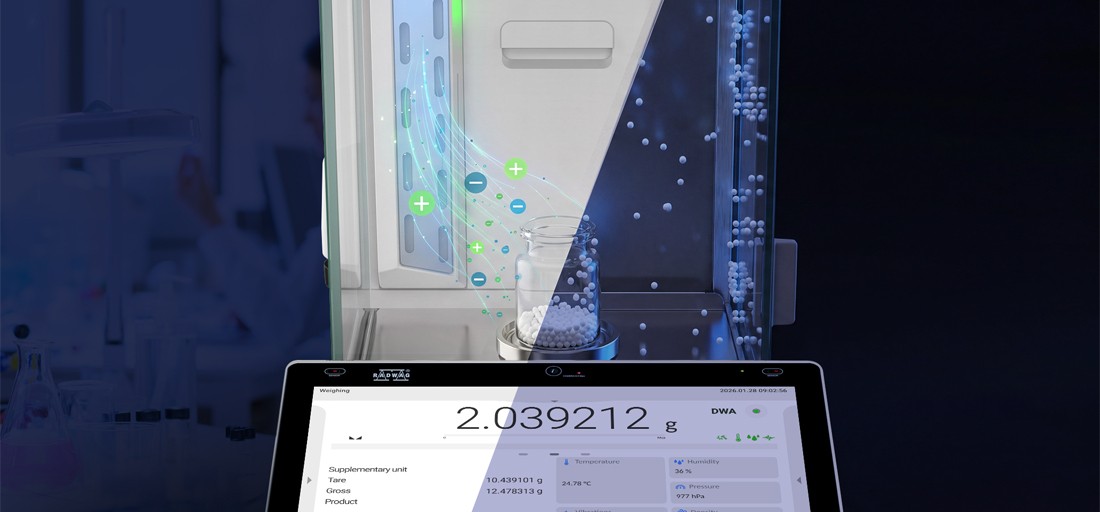
The World’s Most Expensive Gram. Where Does Weighing Accuracy Determine Losses Running Into Millions?

In many production processes, a balance is one of the last pieces of equipment we pay attention to – after all, it is merely a tool for determining mass. However, in industries where raw materials cost a fortune and formulations and processes demand exceptional accuracy, the weighing result can have a direct impact on product quality, process safety and financial performance.
In such circumstances, one could say that there is such a thing as the world’s most expensive gram. This is not about a specific substance, but rather a situation in which a small measurement error, repeated hundreds or thousands of times, leads to enormous losses.
When Does a Gram Cease to Be Just a Gram?
Imagine a process in which a material costs tens of thousands per kilogram. In such a case, a difference of just one gram can represent tens in value. While this may seem insignificant in a single weighing, the situation changes rapidly when the same error occurs across thousands of production batches. What is more, the cost of an inaccurate weighing is not always limited to the value of the raw material itself. It can also result in wasted material, rejected batches, production downtime, the need to repeat a process, or additional quality-control procedures. In high-value industries, even a seemingly minor weighing error can therefore translate into substantial financial losses.
An incorrect mass can mean:
- The rejection of an entire production batch
- The need to repeat the process
- Downtime on the production line
- The loss of expensive material
- Problems with product quality or compliance
- And, in some industries, safety implications as well.
That is why, in advanced manufacturing, weighing accuracy is part of cost and quality control, rather than merely a technical parameter of the equipment.
Pharmaceuticals: Even the Slightest Difference Matters
The pharmaceutical industry is one of the most obvious examples of the importance of precise dosing. When preparing formulations, it is essential to measure active substances, excipients and other ingredients accurately. In many cases, quantities cannot simply be rounded up to whole grams. There are two aspects to this issue. The first is process quality and compliance. The mass of the ingredients must meet the requirements of the formulation and production procedures. The second is the value of the material. Some substances used in the production of medicines are expensive, and the quantities involved may be small. In such situations, not only the resolution of the balance but also its repeatability, stability and resistance to ambient conditions become crucial. In laboratories and pharmaceutical plants, a balance can therefore be one of the fundamental elements of the entire quality assurance system. Precise weighing helps to minimise the risk of both inaccurate dosing and unnecessary wastage of valuable substances.
Semiconductors: Costly Precision at the Micro Level
The semiconductor industry presents an even more demanding environment. The manufacture of integrated circuits requires materials and processes to be controlled with extraordinary precision. Among other things, the industry uses specialised chemicals, high-purity materials and components whose properties must be strictly controlled.
In this world, it is not about how much a single gram of material costs – what matters is how small the quantities need to be measured and how consistently the entire process can be repeated. A measurement error can disrupt the proportions of the components, which may result in the loss of a batch of material or difficulties in achieving the required process parameters. In semiconductor manufacturing, the following are therefore particularly important:
- High measurement resolution
- Repeatability of results
- Stability of readings
- Control of ambient conditions
- The ability to integrate the balance into the production process
- Documentation and traceability of results.
Here, accuracy ceases to be a value stated in the specification; it becomes an integral part of the entire technological process.
Precious Metals: Every Gram Has Its Price
Gold, platinum, palladium and rhodium are materials whose value is directly linked to their mass. That is precisely why, in the precious metals industry, accurate weighing has exceptionally literal financial implications. With large quantities, even a slight difference in mass can amount to a significant sum. This applies equally to the trading of raw materials, as well as to production processes, recycling and the inspection of finished products.
Imagine a plant that processes hundreds of kilograms of material every day. If measurements are consistently subject to a small error, the consequences can be felt across the entire company.
In this industry, it is not just accuracy that counts. The reliability of the measurement is equally important – the ability to demonstrate that the result was obtained using a suitably selected, tested and monitored device. When the material being weighed is worth more than a car, a difference of a few grams is no longer a trifling matter.
Aviation: Kilograms That Matter for Safety
The aviation industry, in turn, demonstrates that the value of accurate weighing cannot always be directly translated into the cost of the material. An aircraft’s mass affects its performance, fuel consumption and flight characteristics. That is why mass control and accurate load calculation are essential elements of aircraft operation and maintenance processes. Here, an extra kilogram does not necessarily mean an expensive raw material. It may signify a specific change in operational parameters. The precision of mass measurement is therefore part of a larger system in which safety, predictability and compliance with technical requirements are paramount. This is a good example of how a ‘costly gram’ does not always mean a gram of expensive material. Sometimes its value stems from the consequences of knowing its mass.
It’s not Just About Accuracy. The Whole Measurement Process Matters
In practice, choosing a balance for a demanding process should not be reduced to a single figure in a specification table. Display resolution is just one factor. Equally important are:
- Repeatability – do successive weighings of the same sample yield comparable results?
- Stability – does the reading remain reliable under variable operating conditions?
- Ambient conditions – how do temperature, humidity, vibrations or air movement affect the measurement?
- Calibration and monitoring – can the device be properly monitored and checked?
- Process integration – can results be automatically recorded, transmitted and analysed?
- Ergonomics – is the operator able to carry out the measurement quickly and without unnecessary risk of error?
It is precisely the combination of these elements that determines the true value of a weighing system.
How Much Does Inaccurate Weighing Really Cost?
The easiest way to look at this problem is through a simple formula:
cost of error = value of material × error margin × number of operations
In reality, the calculation is more complicated, as indirect costs must be factored in: labour, energy, downtime, re-testing, waste or lost batches.
Therefore, an investment in a more advanced weighing system should not be assessed solely on the basis of the equipment’s price. Sometimes the most expensive balance is the one that is not accurate enough for a given process.
Balance as a Cost-Control Tool
In a modern enterprise, a balance can serve a much greater purpose than simply indicating mass. It can act as a quality control point, a component of a dosing system, a source of production data and a tool for minimising material wastage. That is why, in sectors such as pharmaceuticals, semiconductors, precious metals and aerospace, it is worth taking a broader view of weighing. Let’s not just ask how accurately a balance measures. It is better to ask what value each weighing result represents for us. Sometimes, the answer is a few. Sometimes, it is several thousand. And in the most demanding processes – millions.
This is precisely why weighing accuracy can be one of the most cost-effective investments in the entire production process.