Maximum Precision at Minimum Sample Quantity. Microbalance, What Is It and What Is It Used For?

 Numerous customers often wonder what is important and what to take into account while selecting a microbalance. Before we address this issue, let us explain first what kind of a device the microbalance is and what it is used for. We hope that this text will clear up any doubts concerning this weighing instrument.
Microbalance, What Is It and What Is It Used For?
Microbalance is a very precise laboratory device, this as a consequence gives unmatched repeatability values (from 0.15 μg). Its readability is impressively high (from 1 µg), and the maximum capacity – very small (to ca. 50 g). These three features distinguish the microbalance making it a perfect weighing device for a very small mass.
Microbalance - Intended Use
Microbalance, as an extremely accurate instrument is used in research laboratories, to name just a few: pharmaceutical, physical, chemical, biological and medical. Thanks to the best technical specification the microbalance is proven to be a perfect solution for the most advanced weighing laboratory processes.
What Should Be Taken into Account While Selecting a Microbalance?
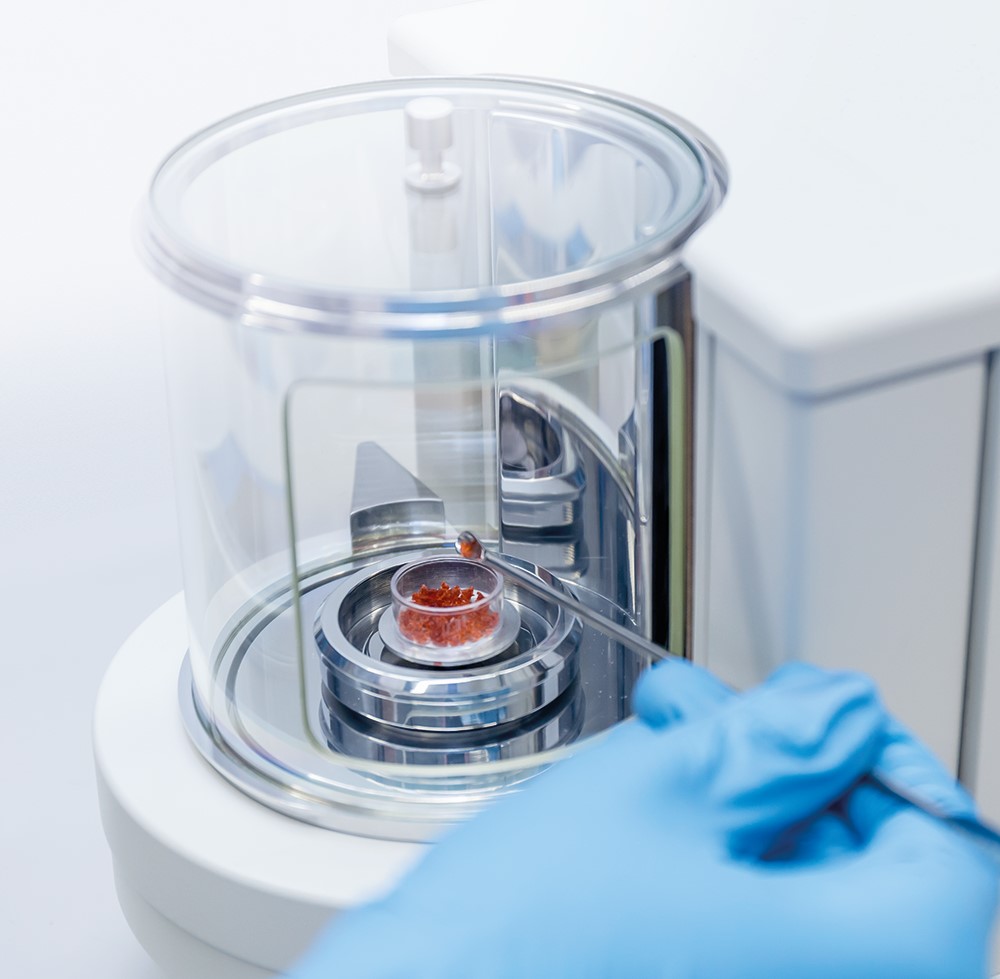
Ambient conditions and the type of weighed sample both play significant role in the process of correct balance operation. Only when we provide optimal ambient conditions in the laboratory, we can analyse parameters of the microbalance, its functionality, dedicated accessories, compliance with the regulations (verification, 21 CFR and USP), services (calibration, qualification and validation), compatibility with other devices, ease of operation and work ergonomics, plus service and price.
I. Microbalance Parameters
1. Microbalance Repeatability
Repeatability is a balance ability to provide identical result for one and the same load weighed several times under identical conditions.
Repeatability is expressed as a standard deviation, i.e., SD. It is wise to select balances with small SD, since small SD value is an evidence of the greatest measurement precision. RADWAG microbalances offer the best possible standard deviation on the market, 0.15 μg.
2. Microbalance Linearity
Linearity is defined as a deviation of real balance characteristics from a straight line connecting two points: zero and maximum. Since no balance is an ideal machine, its characteristics will never be a straight line, however a straight line is a desired standard.
Linearity describes maximum indication error in a given measurement point.
3. Minimum Weight
Minimum Weight determines low limit of the balance weighing range, below which conditions required for precise weighing regulated by USP (United States Pharmacopeia) are not met. IN order to select a microbalance that suits our requirements we need to know the value of a minimum weight respective for our weighing process.

4. Microbalance Stabilisation Time – Time Required for Stable Measurement
While selecting a device as accurate as the microbalance, it is necessary to consider whether we care more for measurement precision or weighing speed. If the priority is precision than it is a must to pay attention to the repeatability, in the case when speed is crucial, make sure that the stabilisation time is right.
Balance stabilisation time is measured from the very moment a load is placed on the pan to the moment a stable indication is obtained. This is why it is advisable to select a microbalance that will allow to adjust the stabilisation time to the weighing process. Keep in mind that the shortest stabilisation time does not mean the best weighing results, i.e., the utmost precision.
II. Microbalance Functionality 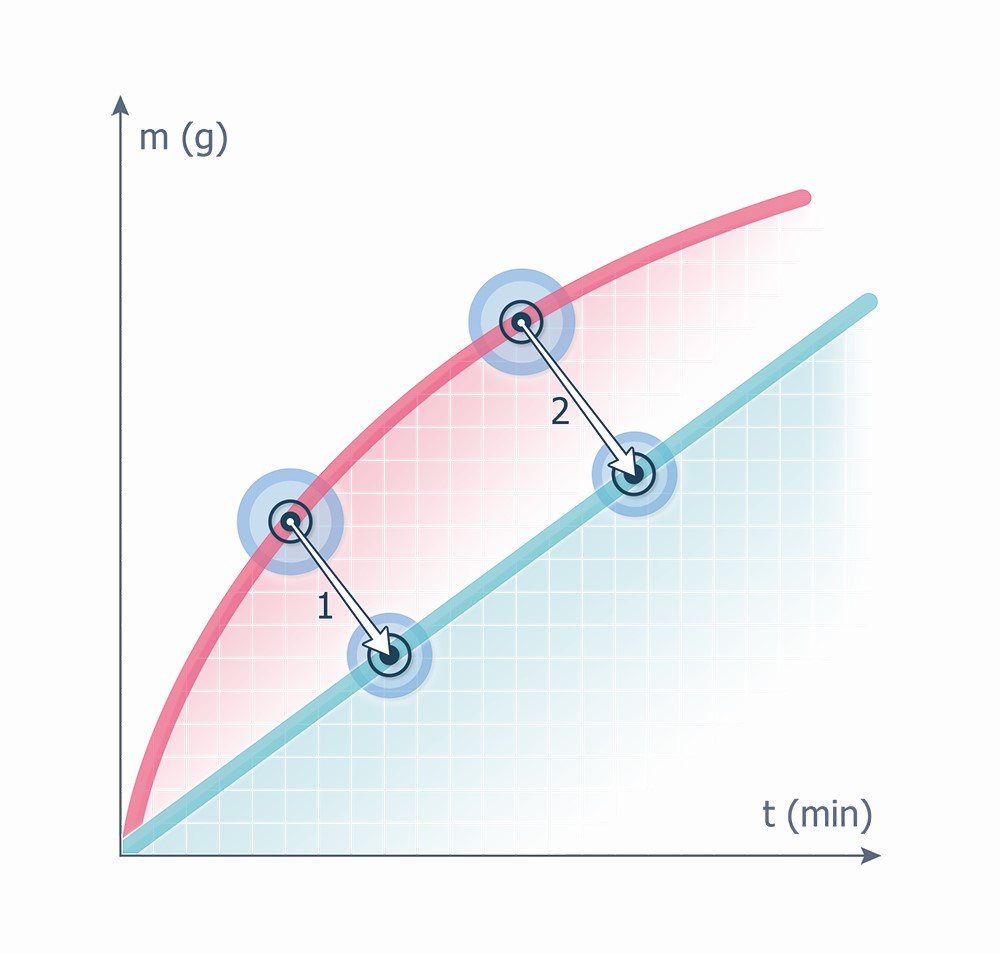
1. Microbalance Adjustment Measured in Two Points
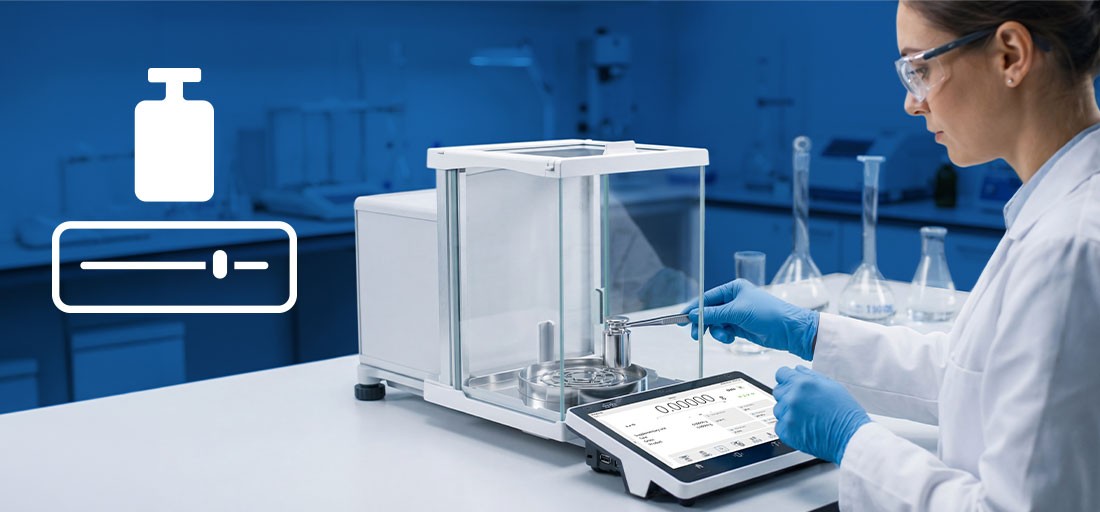
Balance Adjustment aims to correct indication error and as a result to increase balance precision. It consists in comparison of the weighing result of an internal balance weigh with its previously determined value.
In the case of a microbalance, it is important to carry out the adjustment in two points, with this:
- the highest measurement precision within the whole weighing range is guaranteed,
- linearity errors are limited to the very minimum,
- errors due to ambient conditions change and gravity coefficient are eliminated.
2. Integrated Antistatic Ionizer/ External Antistatic Ionizer
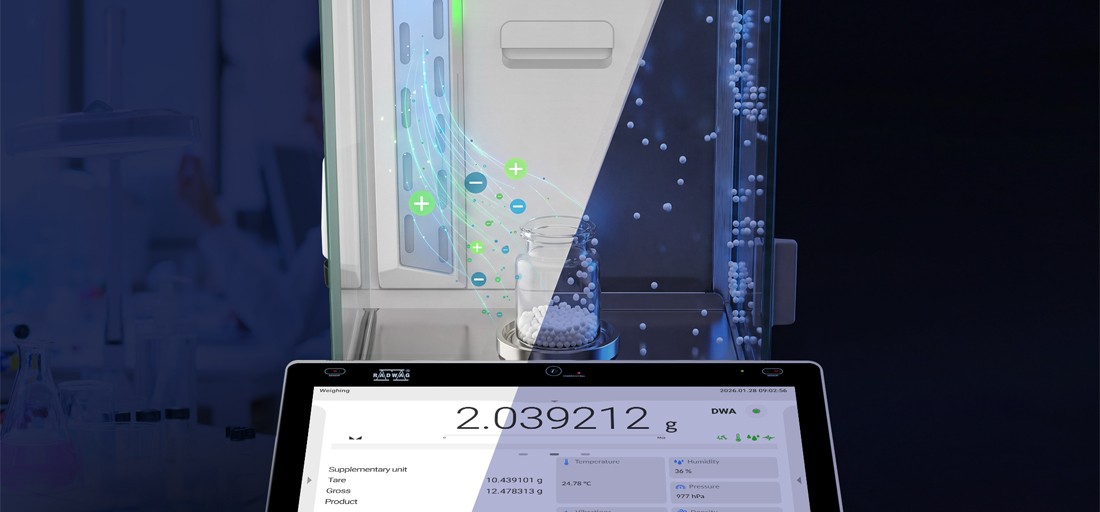
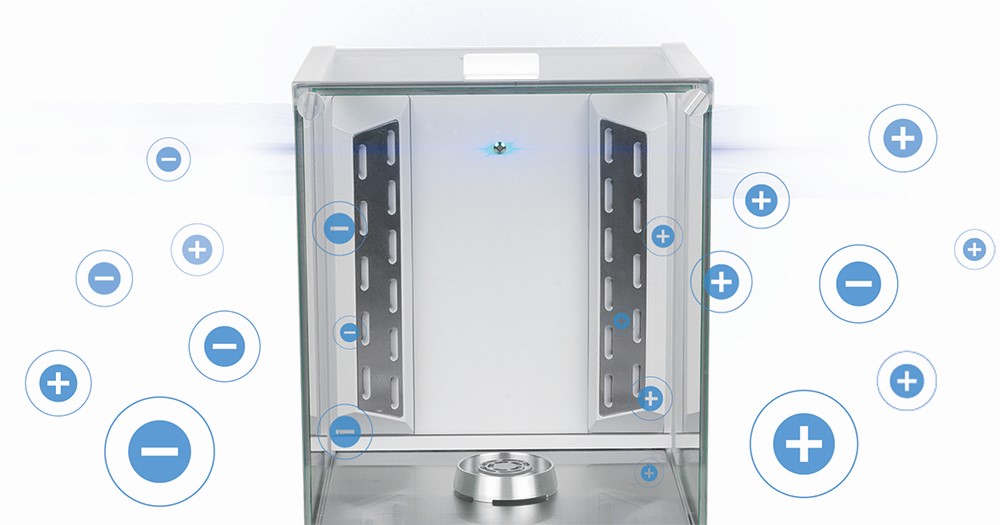 It is worth to pay attention to ionization function, that is, to make sure if the microbalance has been equipped with an antistatic ionizer, which neutralizes electrostatic charges of the sample. Ionizer operation may be interrelated with the automatically open weighing chamber. Thanks to this, during each weighing (i.e., every time the chamber opens) the ionizer will neutralize influence of the charges onto the weighing process.
Electrostatic charge of the sample may directly affect the balance, and as a result make weighing of the sample impossible. Thanks to the integrated ionizer, the user, after neutralisation of the charge, can carry out weighing of the sample. Additionally, the weighing chamber inside should be covered with a special antistatic layer minimizing the electrostatic charges influence.
3. Automatic Weighing Chamber
It is important to select such a microbalance that is equipped with an automatic weighing chamber, opened with a hand gesture thanks to installed infrared sensors (IR).
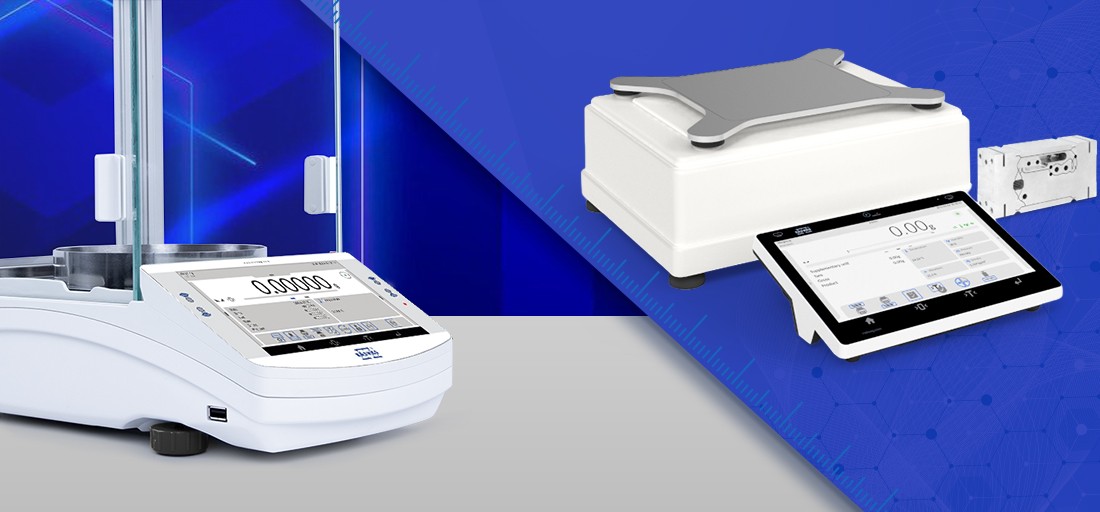
Modular construction of the microbalance and possibility to replace the weighing chamber are excruciatingly important features, they both boost the scope of microbalance use. Thanks to the above, the microbalance can function as a device for pipette calibration, instrument for filter weighing and a susceptometer.
4. Automatic Microbalance Levelling (ReflexLEVEL System) 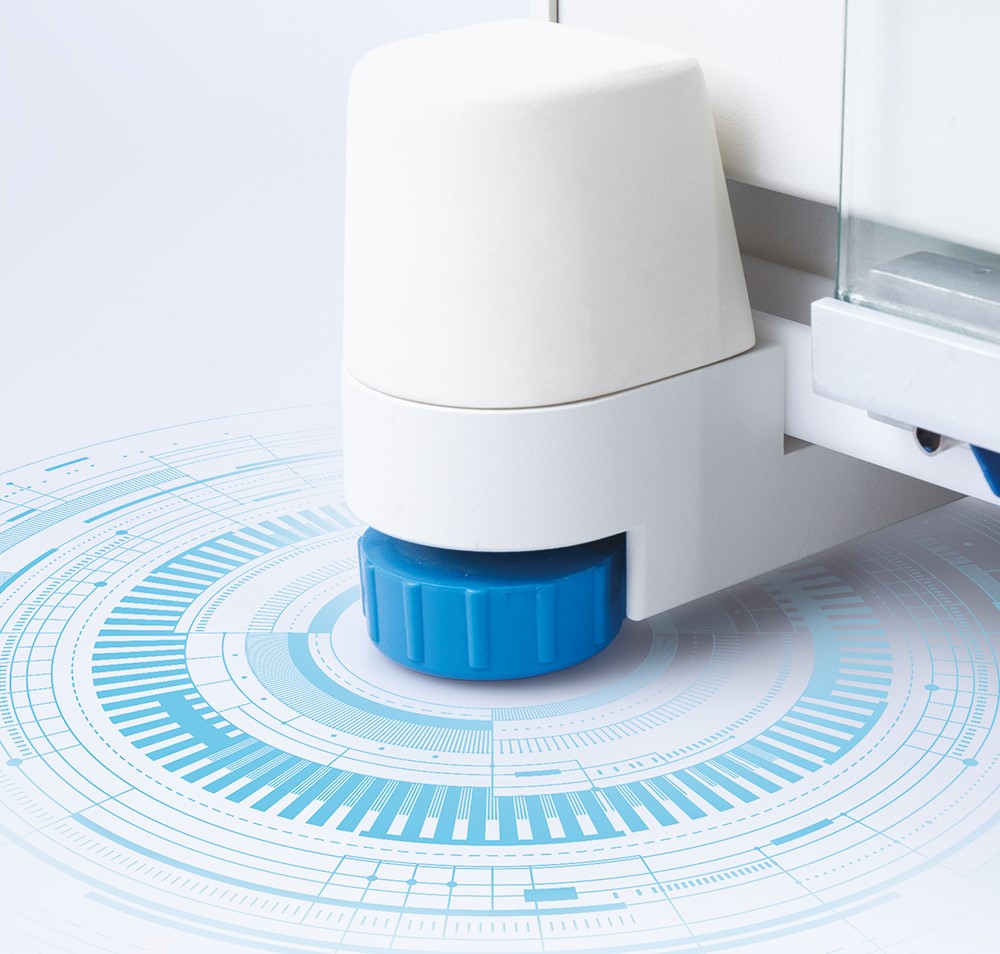
Correct levelling of the balance in consequence gives precise and repeatable indications. It is recommended to select a microbalance with automatic levelling function. Such a solution provides convenience, and is less time consuming. Most of all, it guarantees model position of the measuring system and gives maximally precise measurement results.
Alternative option for balance auto levelling is semi-automatic levelling, i.e., so called LevelSENSING System. It is a perfect solution for those who have lower budget. Semi-automatic levelling has a great advantage over the manual levelling, in the case of the former one the user is prompted in which direction to level the balance. This shortens the very process.
5. Used Working Modes
While purchasing a microbalance it is worth to choose one with advanced working modes such as formulation, SQC (Statistical Quality Control) or differential weighing.
III. Microbalance Accessories
1. Weighing Tables Intended for the Microbalance
Quality and advancement of the weighing device have a great impact onto the measurement accuracy, but also crucial are the conditions prevailing in the weighing room. Measurement errors are a result of, among many, ground vibrations, which can be eliminated by use of anti-vibration weighing tables.
Weighing tables differ one form another by material, construction and intended use. We offer tables with a granite top and professional weighing workstations.
2. External Software
Balances not only weigh but also store, process and send data, to enable this a respective software is needed. It is worth to select a microbalance equipped with software enabling complex support of all processes realised in a laboratory. Such software allows comprehensive reporting and is integrated with external IT systems of the user.

3. Miscellaneous Accessories Dedicated for a Microbalance, e.g., Adapters for Pipette Calibration
When selecting a microbalance, it is good to pay attention to availability of dedicated accessories, for example adapters for pipette calibration, designed to enable performance of the calibration procedure and test of piston pipette volume. Use of such an adapter minimizes evaporation effect and reduces air drafts.
IV. Compatibility with Other Devices
Another criterion worth to be taken into account when selecting a microbalance is its compatibility with other instruments. Microbalances feature interfaces enabling cooperation with numerous peripheral devices. Depending on the advancement level of the balance, these may be: a printer, a computer, a PLC controller, a mobile device, a barcode scanner, an additional display, and even an ambient conditions module.
V. Intuitive, Contactless Operation and Ergonomics
If you were to choose between a microbalance easy to operate and a microbalance that is not a user-friendly device you would probably go for the first one. Colour touch screen of optimal size, easy access to an application and weighing functions plus complete customization of the terminal that guarantees ergonomics of operation, all these are features not worth to be put on the margin. Many customers of RADWAG value our products for the fact that it is so easy and so good to work with them. The intuitiveness of our devices is praised especially by those who have operated balances of other brands.
VI. Fast (Quickly Reacting) Service
In accordance with valid regulations, constant monitoring of the weighing equipment is a must. It is worth to make sure that the brand we decide to invest in, offers professional and fast service. Repairs, spare parts, post-sale support and extra services, such as consultancy, technical inspection and maintenance, all this should be guaranteed by a microbalance manufacturer.
VII. Microbalance Price
Price is a highly important criterion when it comes to selection of this weighing device. RADWAG offers microbalances of the top class for the lowest market price.
 Should you have any questions regarding RADWAG microbalance product range or any doubts which microbalance to select, simply contact our expert.