Radwag Balances and Scales - Advanced Weighing Technologies
2024-08-06

What Is an Analytical Balance Used for? RADWAG Analytical Balances: Functions and Applications

What Is an Analytical Balance Used for? RADWAG Analytical Balances: Functions and Applications

What Is an Analytical Balance Used for? RADWAG Analytical Balances: Functions and Applications
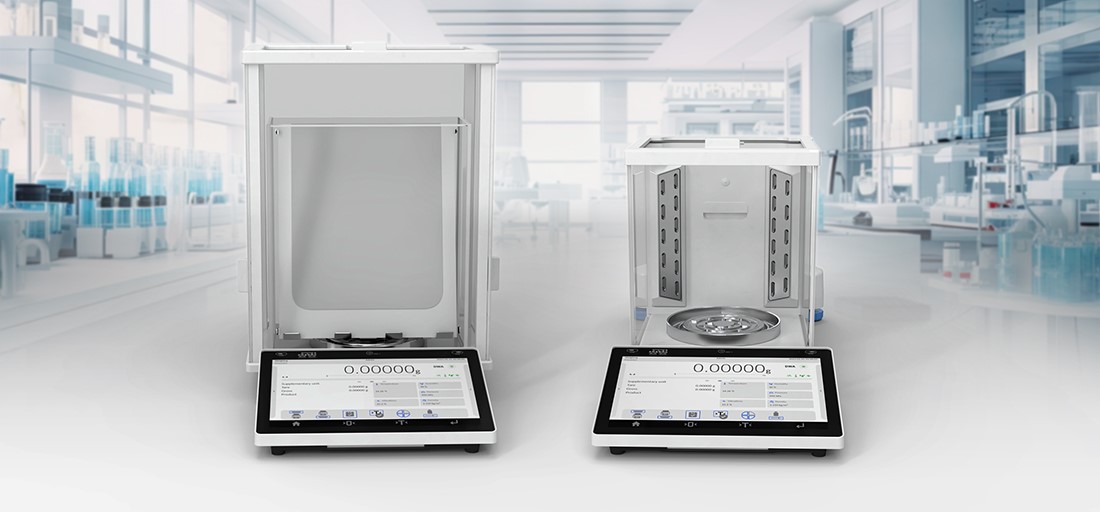
 

An analytical balance is a measuring device that is characterized by very good repeatability as well as high both readability and resolution. What is an analytical balance used for? What functions and applications does it have?

What Is an Analytical Balance Used for? Applications

An analytical balance is intended for weighing small masses. This laboratory balance is used precisely in laboratories, including medical, pharmaceutical, biological, chemical and physical ones.

Analytical Balance – Functions

Analytical Balance Adjustment

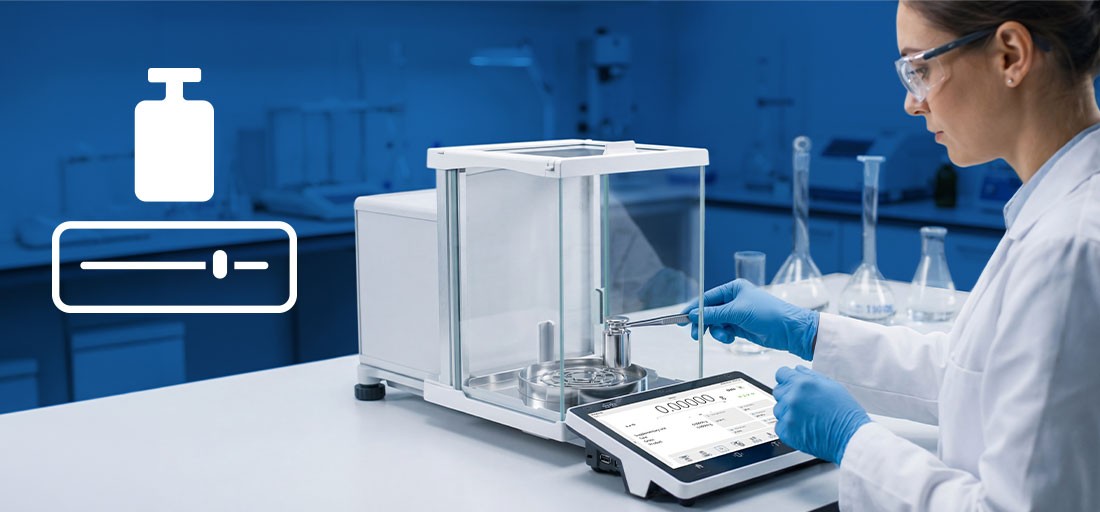
Balance adjustment is aimed at correcting the indication error, that is, maximizing the precision of the balance. It involves comparing the weighing result of an internal balance weight with its previously determined value.

The best solution is 2-Point Adjustment, which helps:

  • Achieve the highest measurement precision within the whole weighing range
  • Minimize linearity errors
  • Eliminate errors due to ambient conditions change and gravity coefficient.

Analytical Balance with an Integrated Antistatic Ionizer/ External Antistatic Ionizer

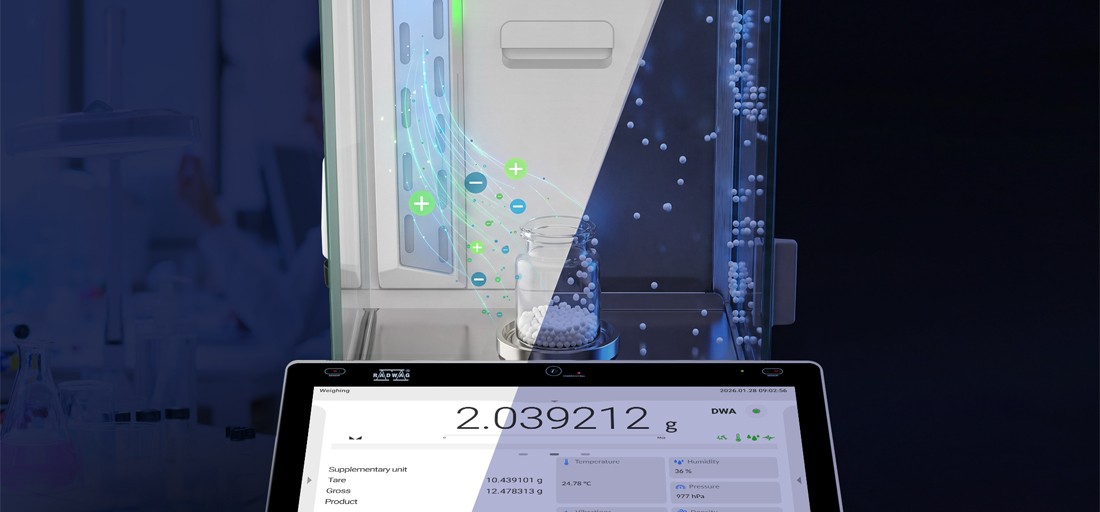
An analytical balance equipped with an antistatic ionizer neutralizes the electrostatic charge of the sample. If the balance additionally has an automatically open weighing chamber, the ionizer will neutralize the effect of charges on each weighing process, so each time the chamber is opened.

The electrostatic charge of the sample may prevent it from being weighed. The built-in ionizer will allow the sample to be weighed because it will neutralize this charge. The inside of the weighing chamber covered with a special antistatic layer will have a similar effect.

The external ionizer works on the same principle as the integrated one.

Analytical Balance Weighing Chamber

RADWAG analytical balances have a manual or automatic weighing chamber. You can open the automatic one using gestures thanks to infrared (IR) sensors. Non-contact opening and closing of the weighing chamber eliminates any vibrations that interfere with the measurement, allows you to define the degree of opening of the door and improves the work ergonomics.

An issue also worth noting is the quick and tool-free disassembly of the weighing chamber. This makes it much easier to clean as well as transport and install the balance in special weighing rooms, such as a glove box or laminar chamber. The easily removable weighing chamber is found in all RADWAG analytical balances.

Analytical Balance Levelling

A correctly levelled balance translates into precise and repeatable readings. RADWAG analytical balances can be levelled:

  • Manually
  • Semi-automatically (LevelSENSING System)
  • Automatically (Reflex Level System, or auto-levelling).

When manually levelling the balance, the level indicator placed on the front of the balance allows you to quickly control the correct levelling. During semi-automatic levelling, the balance prompts the user how to adjust the level of the device; this means that semi-automatic levelling implemented by LevelSENSING System is more user-friendly and less time-consuming than the manual one. The most convenient and the fastest is auto-levelling, which not only guarantees the ideal position of the measuring system and the most precise measurement results, but also alerts when the balance is out of level. In addition, the fact that the balance is correctly levelled is confirmed in the calibration report, which is a prerequisite for the use of the balance in the pharmaceutical industry, for example.

We kindly invite you to learn more about the analytical balances offered by RADWAG.

Newsletter

Subscribe to the newsletter if you would like to receive RADWAG news.

View more
Polish Quality on a Global Scale. Discover RADWAG
2026-09-09
2 min read

Polish Quality on a Global Scale. Discover RADWAG

Hundreds of carefully considered decisions, in-house production and attention to detail – discover what lies behind the quality of our products.
More  ➜
Is It Possible to Weigh Something You Cannot Touch? On the Unusual Uses of Laboratory Balances
2026-08-25
5 min read

Is It Possible to Weigh Something You Cannot Touch? On the Unusual Uses of Laboratory Balances

When we think of weighing, we usually picture a simple process: we place an object on a weighing pan and read its mass. In reality, modern metrology goes far beyond this scenario.
More  ➜
The Use of Analytical Balances. Why Is Measurement Accuracy so Important?
2026-08-11
4 min read

The Use of Analytical Balances. Why Is Measurement Accuracy so Important?

In laboratories, every fraction of a gram can affect the final test result. That is why analytical balances are among the most important measuring instruments used in research, industrial, pharmaceutical and university laboratories.
More  ➜
Is Mass a Constant? Factors Affecting the Measurement Result
2026-07-28
4 min read

Is Mass a Constant? Factors Affecting the Measurement Result

At first glance, the answer seems obvious. If an object has a mass of 100 grams, it should always weigh 100 grams. However, in metrological practice, the situation is much more complex.
More  ➜
Electrostatics – the Silent Precision Killer
2026-07-14
4 min read

Electrostatics – the Silent Precision Killer

On the one hand, accurate balance, controlled conditions and an experienced operator; on the other, inconsistent results. One of the most commonly overlooked culprits is electrostatic charge – a phenomenon which is exceptionally effective at interfering with mass measurements.
More  ➜
Analytical vs. Precision Balances – When Are You Paying too Much, and When Are You Taking a Risk?
2026-06-30
5 min read

Analytical vs. Precision Balances – When Are You Paying too Much, and When Are You Taking a Risk?

Choosing the right laboratory balance often seems straightforward – until the moment you have to make a purchase decision.
More  ➜
How Often Should a Balance Be Calibrated in a Lab Environment?
2026-06-17
1 min read

How Often Should a Balance Be Calibrated in a Lab Environment?

Calibrating a laboratory balance is essential for obtaining reliable measurement results. Find out how often it should be done and in which situations it is absolutely essential.
More  ➜
What Is ‘Calibration’ and How Does It Differ From Adjustment?
2026-05-26
3 min read

What Is ‘Calibration’ and How Does It Differ From Adjustment?

‘Calibration’ is a term historically associated with the balance adjustment process. Adjustment, on the other hand, is a set of activities through which a measuring instrument is made to operate in accordance with its intended use.
More  ➜
Effective Laboratory Management. How Does Process Automation Improve Efficiency?
2026-05-12
5 min read

Effective Laboratory Management. How Does Process Automation Improve Efficiency?

The growing number of tests, the need to maintain the highest quality of results, and the limited availability of qualified staff mean that laboratory management today requires not only organisational skills but also the informed use of modern technologies.
More  ➜
Moisture Analyzer as a Quality Control Tool in Plastics Production – Accuracy and Effectiveness of RADWAG Technology
2026-04-28
3 min read

Moisture Analyzer as a Quality Control Tool in Plastics Production – Accuracy and Effectiveness of RADWAG Technology

In modern plastics production, precise control of granule moisture content determines the stability of the technological process, the strength of parts and the minimisation of material losses. Read how RADWAG’s technological solutions allow your company to achieve full repeatability and process safety.
More  ➜
How Much Does a Lab Technician’s Time Cost You? The Hidden Costs of Manual Calibration
2026-04-14
4 min read

How Much Does a Lab Technician’s Time Cost You? The Hidden Costs of Manual Calibration

Although manual pipette calibration is still widely used, it significantly increases working time and generates hidden costs which often go unnoticed in day-to-day laboratory operations. Fortunately, there are modern solutions available which can boost laboratory productivity.
More  ➜
Pallet Scale vs. Beam Scale – a Complete Guide to Industrial Scales
2026-03-31
5 min read

Pallet Scale vs. Beam Scale – a Complete Guide to Industrial Scales

How does a U-type pallet scale differ from a beam scale? Are beam scales suitable for weighing machines and tanks? Why is it worth buying a pallet scale directly from the manufacturer? You will find answers to these and other questions in this article.
More  ➜
What Does ‘Precision Balances’ Mean?
2026-03-17
2 min read

What Does ‘Precision Balances’ Mean?

Are precision balances inherently more precise than other balances? After all, the range of electronic balances includes laboratory balances, which are even more accurate, so where does this name come from?
More  ➜
« Back

© 2026 RADWAG Balances and Scales.

All rights reserved.