18 Reasons Why RADWAG Ultra-Microbalances and Microbalances Are the Number 1 Choice


RADWAG’s ultra-microbalances and microbalances are devices which guarantee not only unprecedented accuracy, but also functionality, safety and ease of integration with IT systems. Here are 18 specific reasons why you should trust us.
1. Advanced Databases – Full Control Over the Process
Our balances allow you to create and manage comprehensive databases (including Operators, Products, Formulations, Pipettes, Minimum Sample, Warehouses, etc.). All data can be easily exported or imported via a USB stick, allowing the same databases to be duplicated on multiple balances within a series. This solution guarantees a uniform working environment throughout the laboratory or production facility.
2. Wide Range of Communication Interfaces
The standard equipment of our balances includes the most important connectors: USB (type A and C), Ethernet, RS232, HDMI and Wi-Fi connectivity. Thanks to the unique use of the TCP/IP protocol in the Hotspot function, connection to the balance is fast, stable and secure. The additional module IM02.1 (MediaBox) enables integration with industrial automation systems (e.g. PLC) and increases the communication capabilities with 4 inputs and 4 outputs, an RS232 interface and a Virtual Com port.
3. Record Low Reading Unit [USP]
The UYA model offers the lowest minimum weight value according to USP: just 0.3 mg. This parameter means that even the smallest samples can be weighed with full accuracy and compliance with quality requirements. This is particularly important in pharmaceutical laboratories, where every microgramme of mass matters.
4. Four Login Methods – Maximum Security
Our scales enable user authentication by password, face recognition, fingerprint reader (accessory) and RFID tag*. Only RADWAG offers such a wide range of login options, which allows you to perfectly match the authorisation method to your company’s security policy. Such a solution minimises the risk of unauthorised access, ensures full traceability of activities and meets the most stringent access management requirements.
5. Real-Time Monitoring of Ambient Conditions
The balance monitors important environmental parameters such as temperature, humidity, pressure and vibration as well as calculates air density. Any changes are recorded in real time and presented in the form of clear graphs on the balance’s screen. This function not only alerts the user to potential measurement disturbances, but also allows the user to analyse the impact of the environment on weighing accuracy.
6. Ambient Light – Coloured Information Language
The Ambient Light system uses coloured backlighting to communicate with the user in real time. The colours indicate the current status of the instrument, errors, readiness for operation or correct weighing. This intuitive solution enhances the user experience and allows you to react more quickly to changes in the balance’s status.
7. Digital Archive in Your Hands
Our balances feature a library to which you can add digital versions, in PDF format, of documents such as calibration certificates, qualification documents, etc. The PDF format guarantees the preservation of the original layout and content of the document, making it easy to view and print out later. With a digital archive, you save space, increase data security and better organise your work.
8. Digital Notes – More Than Just Numbers
The user can add a text note to a measurement or procedure being performed at any time. Such notes are saved with the data in the report database, increasing the transparency of the documentation. This is particularly useful in audited environments where a complete history of operations is essential.
9. Graphs and Data Visualisation
Our balances allow you to present data in graphical form, including graphs of weighing, measurement series or probability distributions, a.k.a. Gaussian distributions. You can save the generated graphics as graphic files on a memory stick and attach them to reports or presentations. Such visualisation facilitates analysis, so you can understand the problem more fully.
10. Digital Weighing Auditor (DWA) – We Watch Over the Correctness of Weighing
DWA is an integrated control system which monitors all key elements of the weighing process. Among other things, it monitors levelling, adjustment, ioniser operation, ambient conditions, compliance with standard minimum weight and air buoyancy compensation. It assures the user that each weighing is carried out in accordance with procedures and standards and with the greatest possible accuracy.
11. Non-Standard Printouts – Your Data, Your Format
The non-standard printouts function allows you to create your own templates for reports, printouts and labels incorporating your chosen variables. The templates can be designed either directly on the balance or from a computer as well as a smartphone. It is a tool which allows you to perfectly match your documentation to organisational and regulatory requirements.
12. 21 CFR Part 11 Compliance Without the Need for a PC
Our balances comply with 21 CFR Part 11 regulations without the necessity of an additional computer or external software. This translates into significant resource savings and simplified IT infrastructure. The user gets a fully compliant solution in one device.
13. Data Export Without Additional Software
With the USB Free Link function, you can transfer the measurement result directly to any editable file, such as an Excel sheet, using a USB A-C cable. You do not need any additional drivers or PC applications. USB Free Link makes your daily documentation work easier and faster.
14. Hotspot – Remote Operation of the Balance Without Cables
The Hotspot function allows you to connect to the balance wirelessly and operate it remotely via a web browser. You can take measurements and view data and reports from anywhere, all via Wi-Fi. Authorisation is all that is required to access the full functionality of the device.
15. Integrated Antistatic Ioniser
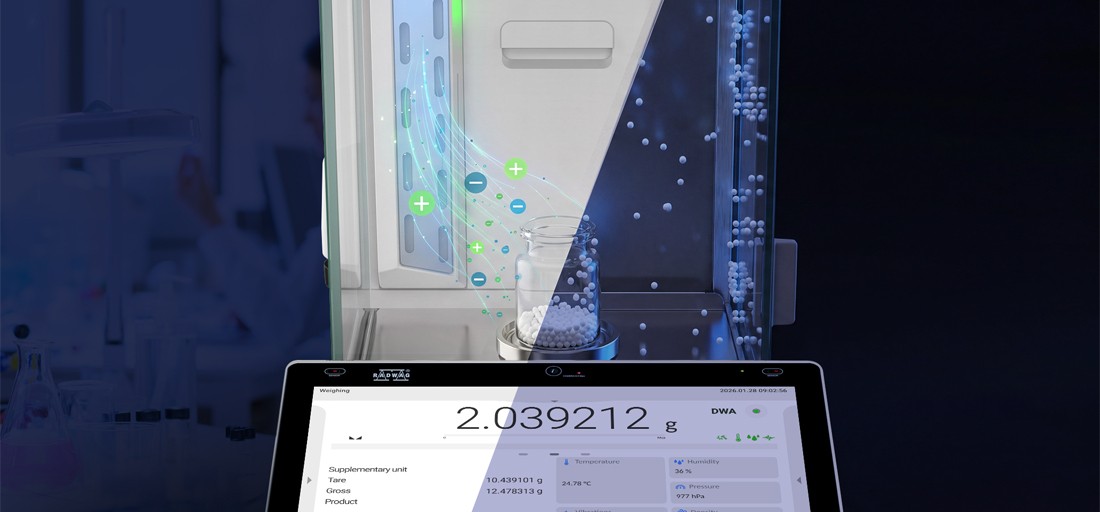
Selected microbalance models are equipped with an ioniser which eliminates electrostatic charges which interfere with measurements. The device starts automatically when the weighing chamber is opened and switches off when it is closed. This is an important feature, especially when working with samples with high electrostatic susceptibility.
16. Reminders for Maintenance, Qualifications and Inspections
A built-in reminder system automatically informs the user of upcoming dates for important activities such as maintenance, IQ/OQ/PQ qualifications or other scheduled inspections. The messages appear on the balance’s screen at just the right time to prevent negligence. This gives you the assurance that all quality maintenance activities are carried out on time and in accordance with procedures.
17. Autotest – Automatic Self-Diagnosis of the Device
The Autotest module is an advanced diagnostic tool which automatically runs a series of internal test measurements using an adjoining mechanism. On their basis, a detailed report is generated assessing the technical condition of the balance, including, among other things, the standard deviation. This function allows the user to regularly verify the correct operation of the instrument without the need for external service.
18. Full ALCOA+ Compliance for Safe and Transparent Weighing
RADWAG balances comply with the ALCOA+ standard as they ensure the highest level of data integrity in regulated environments such as the pharmaceutical, chemical and food industries. Our equipment records data in real time and assigns it to specific users, while guaranteeing the completeness, consistency and availability of information. With audit functions, access control and integration with LIMS or ERP systems, RADWAG supports companies in maintaining compliance with FDA and GMP requirements.
18 Is Just the Beginning
Our ultra-microbalances and microbalances are not just technology – they are tools designed for the highest accuracy, ergonomics and compliance with the most stringent standards. There are many more possibilities of ultra-microbalances and microbalances, but you can learn them best… in practice.
RADWAG – We Weigh With the Precision of the Future.
Are you ready to meet it?
__________
Wi-Fi® is a registered trademark of Wi-Fi Alliance®.
* RFID ISO/IEC 14443 Type A, 13,56 MHz