What Is the Deal with Measurement Speed? Facts, Myths and Our Approach at RADWAG


We often hear the question: ‘Which balance is the fastest?’ And rightly so – no one likes to wait. Especially in a laboratory, where every second counts and accuracy is paramount. But does ‘speed’ always go hand in hand with readability? And is it worth trusting the results which appear on the display after a fraction of a second? The answer, as is usually the case, is: it depends.
Fast Measurement Versus Readability
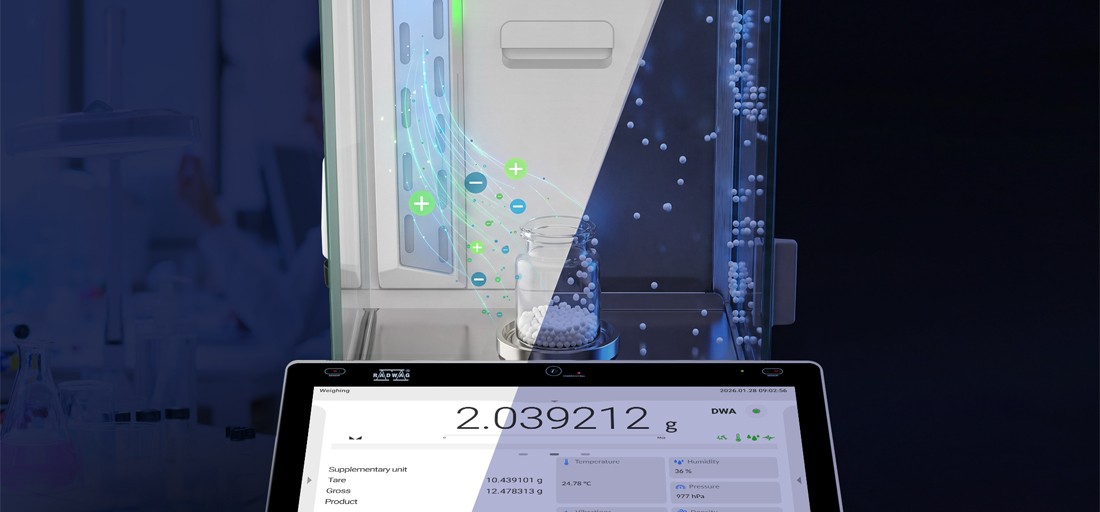
At first glance, it all seems child’s play: we place the sample on the balance, the numbers jump around, stabilize after a moment, and we have the result. But what is really happening? The balance must:
- Register the load
- Suppress vibrations and oscillations
- Correct for ambient conditions (such as temperature, air movement, humidity)
- Identify a stable signal
- Display the result with the appropriate readability, for example 0.01 mg.
In practice – especially with balances as accurate as ultra-microbalances, microbalances and analytical balances – this process must take time. Physics cannot be cheated. At least if we want a result which means something.
How Do Others Do it?
Some companies, in pursuit of ‘speed’, use various tricks. They:
- Display a temporary result before it is fully stabilized
- Lower the threshold for detecting changes, which makes the numbers ‘freeze’ faster – but they are less reliable
- Use software to mask instability – the screen shows 0.0000, but the signal is still changing.
What happens then? The result is fast, but not always accurate, and the user is unaware that their data may be flawed.
How Does it Work at RADWAG?
For years, we have been committed to measurement integrity. RADWAG balances have advanced signal filtering algorithms which reduce measurement time without compromising accuracy. Our advantages are:
- Real stabilization time
Our measurement time is the time it takes to obtain a reliable result, not just a nice-looking number.
- Integrated anti-vibration and compensation systems
which allow you to speed up measurement in difficult conditions.
- DUAL-READABILITY innovations
enabling faster readings while maintaining the highest readability.
- Reliable data in specifications
If we say that the stabilization time is 2 seconds, it means that after 2 seconds you have an accurate and stable result, not just the first numbers which come along.
Accurate Measurement Is Essential
Speed is important, but the reliability of results is even more important. This is especially true where every microgram counts – in pharmaceutical and chemical laboratories or in quality control. That is why at RADWAG we focus on transparency. You will not find ‘magical’ measurements achieved in 0.5 seconds with a readability of 0.01 mg, because we know that this is simply impossible without the risk of error.
Summary
When choosing a balance, ask yourself whether you care more about speed or measurement quality. At RADWAG, we believe that one does not have to exclude the other – but only if we rely on real technology, not marketing gimmicks. Because precision is not just a matter of equipment – it is a matter of trust.